
.svg)


.svg)
See Where Trainery Fits Your Situation
Bring your current TalentLMS setup to the call. We'll walk through how Trainery handles compliance history, ILT scheduling, and reporting differently, with your own use case, not a generic demo.
TalentLMS suits small teams, but its G2 reviews skew toward small businesses. Cracks show with audit-ready compliance, ILT scheduling, or external training gaps tied to its lack of a SOC 2, retakes overwriting history, and shallow reporting.
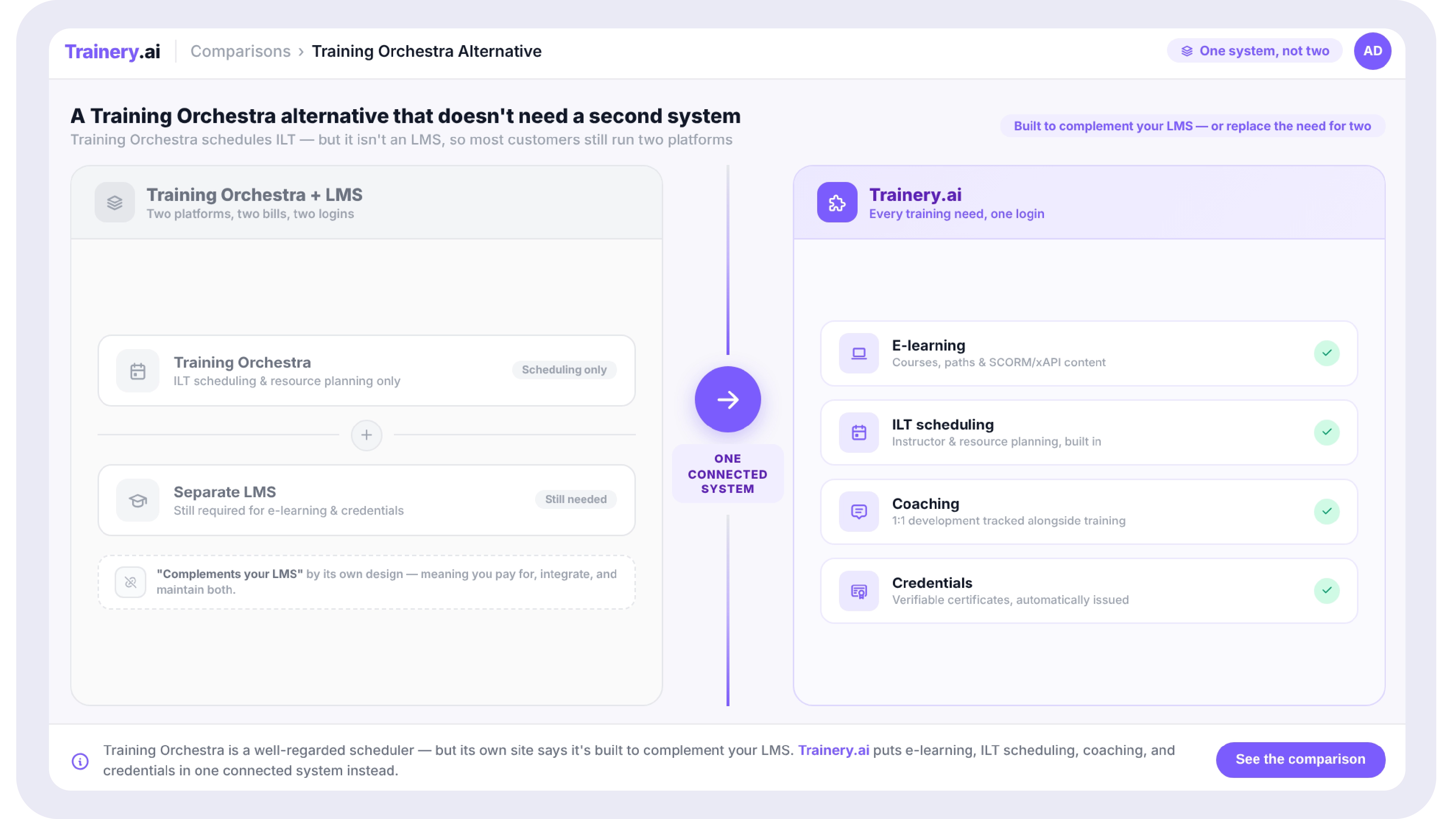
Four patterns come up repeatedly in real user reviews of TalentLMS, not marketing claims.
A quick scan before the full breakdown below.
Platform
Best For
Starting Price
Pricing Model
Trainery
Teams that want e-learning, ILT scheduling, coaching, and credentials in one connected platform
Custom (modular)
Per module, per user
Docebo
Teams wanting an AI-driven LMS with a deep content marketplace and gamification
Custom (tiered)
Active-user bands
Absorb LMS
Regulated industries needing strong compliance tracking and audit trails
Custom quote
Per active user, annual
LearnUpon
Organizations training employees, partners, and customers from one LMS
Custom (3 tiers)
Tiered by user count
360Learning
Teams that want employees and SMEs co-creating courses together
Custom quote
Per active user
SkyPrep
Small and mid-sized teams wanting a simple LMS without a long rollout
Custom quote
Per active user
Thinkific Plus
Organizations that want to package and sell training as a paid product
Custom quote
Per active user / course sales
Cornerstone OnDemand
Large enterprises bundling learning inside a broader HCM/talent suite
Custom
Module + user-count based
Best For
Teams that want e-learning, ILT scheduling, coaching, and credentials in one connected platform
Starting Price
Custom (modular)
Pricing Model
Per module, per user
Best For
Teams wanting an AI-driven LMS with a deep content marketplace and gamification
Starting Price
Custom (tiered)
Pricing Model
Active-user bands
Best For
Regulated industries needing strong compliance tracking and audit trails
Starting Price
Custom quote
Pricing Model
Per active user, annual
Best For
Organizations training employees, partners, and customers from one LMS
Starting Price
Custom (3 tiers)
Pricing Model
Tiered by user count
Best For
Teams that want employees and SMEs co-creating courses together
Starting Price
Custom quote
Pricing Model
Per active user
Best For
Small and mid-sized teams wanting a simple LMS without a long rollout
Starting Price
Custom quote
Pricing Model
Per active user
Best For
Organizations that want to package and sell training as a paid product
Starting Price
Custom quote
Pricing Model
Per active user / course sales
Best For
Large enterprises bundling learning inside a broader HCM/talent suite
Starting Price
Custom
Pricing Model
Module + user-count based
A full breakdown of who each platform actually serves, and where each one's real strengths and limits sit.
The most common mistake in this category is comparing feature lists instead of starting from the actual bottleneck. These five situations cover most real evaluations.
Compare Cognota alternatives & competitors for L&D teams →Compare Cornerstone OnDemand alternatives for enterprise L&D →You need LMS, TMS, coaching, and credentials to run as one connected system, not separately licensed tools
You want a deep content marketplace, gamification, and AI-driven content tools
You're in a regulated industry that needs strong compliance tracking and audit trails above all else
You train employees, partners, and customers from one LMS with separate branded portals
You want to package and sell training as a paid product to the public, not just deliver it internally
You're already deep in Cornerstone's or another major HCM ecosystem and want learning bundled in


Trainery is the most direct fit, since it combines e-learning delivery and ILT scheduling in one platform rather than requiring a separate LMS contract alongside the TMS. SAP Litmos and Docebo also include both, though their ILT scheduling is either integration-dependent (Litmos) or lacks session-level enrollment automation (Docebo) compared to a dedicated TMS.
It can be, but several of its modules, particularly Training as a Business and Client Collaboration, are built for organizations that sell training as a commercial product. Internal-only L&D teams training just their own workforce may find better-scoped, less expensive options among platforms built primarily for corporate L&D rather than training providers.
Training Orchestra, Administrate, and accessplanit all price through custom enterprise quotes with no published rate card. Trainery also uses custom pricing, but structures it modularly: organizations can start with a single module such as TraineryTMS and add others as needs grow, rather than committing to full platform scope upfront.
Arlo and accessplanit are both purpose-built for this use case, with registration, payment processing, and CRM tools designed around selling training as a product. Training Orchestra's Training as a Business module covers similar ground for organizations already invested in its broader TMS.
Cognota is built specifically for that problem. It doesn't replace an LMS or TMS, it sits above both, centralizing how training requests are submitted, prioritized, and resourced, which is a different problem than scheduling instructor-led sessions.
Yes. Trainery, Arlo, accessplanit, and SAP Litmos all support training customers, partners, or members in addition to employees, each from the same core platform. Cornerstone OnDemand and Docebo can extend to external audiences as well, typically through additional licensing tiers.
Bring your current TalentLMS setup to the call. We'll walk through how Trainery handles compliance history, ILT scheduling, and reporting differently, with your own use case, not a generic demo.
.svg)
.svg)

.svg)
.svg)

