
AI that respects your org culture
Review TrAI governance and rollout controls with the Trainery team, including which features can be enabled, disabled, or scoped for different modules and user roles.
TrAI is Trainery’s AI layer for learning workflows. Current and planned capabilities are identified on this page; confirm live feature availability, module coverage, governance controls, and roadmap commitments during evaluation.
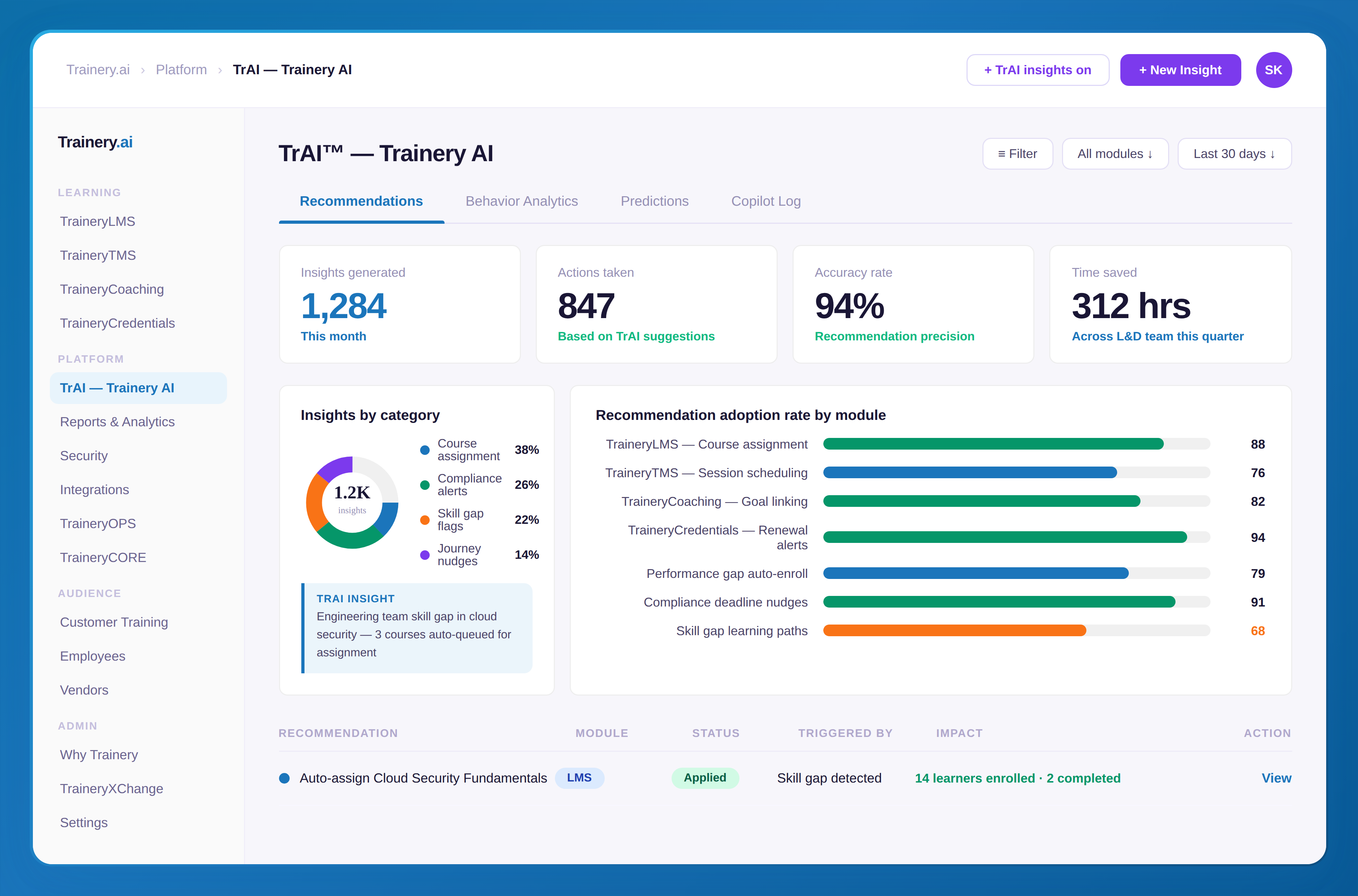

Traditional LMS platforms typically focus on course delivery, completion tracking, and compliance workflows. AI-assisted personalization, content generation, recommendations, and learning intelligence vary by product and should be evaluated separately.

Personalized learning paths, skills tagging, content recommendations, analytics, and workflow automation are common areas to compare across AI-enabled learning platforms. Evaluate each vendor’s live capabilities and governance against your requirements.

Skills intelligence engine. Predictive workforce capability. AI-driven development pathways. Learning + performance + compensation alignment. This is the direction TrAI is building toward.
TrAI is Trainery’s AI layer for learning and development workflows. It brings AI-assisted course creation, content analysis, document-to-learning workflows, and other learning tools into the Trainery environment, with feature availability and module coverage confirmed during evaluation.
TrAI includes current AI-assisted learning capabilities and additional planned features. Use the availability labels below as a guide, and confirm current release status, module coverage, governance controls, and roadmap commitments during evaluation.
.svg)
Use natural-language assistance for training, course, and skill-related questions. TrAI can support course discovery and manager queries about learning progress and skill gaps where the relevant data and permissions are available.
.svg)
.svg)
Use AI to draft structured course content from a topic or source material, then review and refine the output before publishing. The workflow is designed to reduce manual authoring effort without replacing instructional or subject-matter review.

Analyze existing course content against industry standards. Identifies missing topics, outdated information, and skill gaps within content. Scores courses on relevance, completeness, and industry alignment, and provides specific improvement recommendations.
.svg)
Use AI to extract and draft structured learning content from PDFs, policies, or existing training materials. Review generated lessons, flashcards, and quizzes before publishing to confirm accuracy, context, and instructional quality.
.svg)
Planned AI translation workflows are intended to support multilingual course content, captions, and content blocks. Human review remains important for terminology, tone, accessibility, and regulatory or policy-sensitive material.

Planned assessment-generation workflows are intended to draft question types such as multiple choice, short answer, and scenarios from course content. Review generated assessments for accuracy, difficulty, coverage, and alignment before use.
.svg)
Planned skills-mapping capabilities are intended to help connect courses and credentials with relevant skills, support role-based learning recommendations, and surface potential skill gaps. Availability and implementation details should be confirmed during evaluation.
.svg)
Real-time help and explanations for learners during courses. Summarizes lessons and key points on demand. Generates practice questions based on individual progress. Supports personalized learning experiences at scale complementing manager coaching with always-on AI support.

Planned TrAI workflows are intended to help users interpret learning and workforce data, suggest next steps, and surface relevant information through natural-language queries. Confirm which proactive recommendations and data workflows are currently available during evaluation.
Natural-language assistance can help employees and managers find learning information, discover relevant courses, and review available progress or skill-gap data based on their access and the data connected to Trainery.
Generate course outlines from a topic input, including lessons, flashcards, and structured learning modules. Generated content can be edited and customized to reduce manual drafting effort while keeping human review in the workflow.
Analyze existing course content against industry standards. Identifies missing topics, outdated information, and skill gaps within content. Scores courses on relevance, completeness, and industry alignment, and provides specific improvement recommendations.
Upload PDFs, policies, or existing training materials and use AI to extract structured learning content for review. The output can be converted into lessons, flashcards, and quizzes, but source accuracy and context should be validated before publishing.
Behavior and usage data can support analysis and decision-making where the relevant signals are available. Confirm which natural-language queries, pre-fill behaviors, alerts, and recommendations are live for the modules in scope.
Translate course content into multiple languages instantly. Supports full courses, captions, and individual content blocks. Maintains tone and brand voice consistency across languages improving accessibility for global and multilingual learner audiences.
Generate quizzes automatically from course content, multiple question types including MCQ, short answer, and scenario-based. Ensures alignment between lesson content and assessments, reducing manual effort in assessment design while improving quality.
Automatically connects courses and credentials to relevant skills in your organization's skill graph. Recommends learning paths based on user roles. Identifies skill gaps across teams and organizations, providing skill-based progress tracking that goes beyond completion rates.
Real-time help and explanations for learners during courses. Summarizes lessons and key points on demand. Generates practice questions based on individual progress. Supports personalized learning experiences at scale complementing manager coaching with always-on AI support.
These roadmap concepts address common L&D workflow needs. Availability, release timing, integrations, and final behavior should be confirmed against the current product roadmap.
.svg)
A planned learning-path builder is intended to help administrators assemble structured paths from available content, prerequisites, sequencing, and duration inputs. Confirm current availability and supported content sources during evaluation.
.svg)
Planned manager nudges are intended to surface actionable learning signals for teams. Delivery channels, supported integrations, alert logic, and workflow configuration should be confirmed against the current roadmap.
.svg)
Natural-language reporting can help teams interpret learning activity and related operational data. Any claimed performance or productivity impact should be based on the organization’s own measured evidence rather than generated summaries alone.
.svg)
TrAI detects where learners drop out and which content formats work (video vs. reading vs. interactive). Auto-suggests chunking, microlearning alternatives, or better marketplace substitutes. Turns engagement signals into action not just a chart nobody reads.
.svg)
A planned skill-graph layer is intended to connect courses, roles, and other relevant learning data to support personalization and gap analysis. Confirm data sources, update behavior, governance, and current roadmap status.
Compare current, documented capabilities across content creation, skills, learning automation, analytics, governance, integrations, implementation effort, and total cost. Validate each vendor’s live feature set during procurement.
When evaluating Docebo, verify the current AI capabilities, governance controls, content workflows, skills features, integrations, and packaging against your requirements.
.svg)
When evaluating Cornerstone, verify the current AI and skills capabilities, implementation model, integrations, governance, modularity, and total cost for your organization.
.svg)
When evaluating Degreed, verify the current skills, learning-experience, administration, compliance, integration, and reporting capabilities required by your program.


TrAI is Trainery's full AI layer, not a single feature. It includes an AI chatbot for learners and managers, an AI Course Creator that generates outlines and lessons from a topic prompt, a Document Extractor that turns PDFs into structured courses, and an AI Assessment Generator. Skills mapping, learning path automation, and behavior analytics are on the near-term roadmap. Think of it as AI woven into the platform rather than a standalone add-on.
TrAI includes current capabilities as well as roadmap items. Because availability can change, confirm which features are live, which are planned, and any release commitments during the current evaluation.
TrAI can help turn source documents into structured learning drafts. Generated lessons, flashcards, or quizzes should be reviewed against the source material for accuracy, context, permissions, and instructional suitability before publishing.
TrAI personalization depends on the learner data, roles, progress information, and AI capabilities enabled in the implementation. Confirm which recommendation, skills, and natural-language query features are currently available for your use case.
AI controls and rollout options should be reviewed during implementation. Confirm which TrAI features can be enabled, disabled, or scoped by module and user role for the configuration in scope.
Docebo, Cornerstone, and other learning platforms have their own AI capabilities. Compare live features, governance, data handling, integrations, implementation requirements, and roadmap commitments rather than relying on broad category claims.
TrAI feature availability and plan packaging can change as capabilities evolve. Confirm the current live features, roadmap items, and plan inclusion during solution scoping.
Review TrAI governance and rollout controls with the Trainery team, including which features can be enabled, disabled, or scoped for different modules and user roles.
.svg)
.svg)

.svg)
.svg)

