

.svg)

For a long time, "customer training" meant a knowledge base, a handful of webinar recordings, and maybe a PDF onboarding guide that got emailed out and rarely opened again. It sat with customer success, it wasn't measured with any rigor, and L&D had no involvement in it at all.
That's changing not because customer training has become more important in the abstract, but because the organizations doing it well have realized that the discipline required to train customers effectively is the same discipline L&D already applies to employees: structured learning paths, completion tracking, assessments that actually measure understanding, and reporting that connects training to outcomes.
This piece is for L&D and training teams who are being asked sometimes for the first time to think about customer training as part of their remit, and for anyone evaluating whether their current tools can support that without starting from scratch.
Why Customer Training Is Becoming an L&D Conversation
A few converging trends explain why this shift is happening now.
Product complexity has outpaced self-serve documentation.
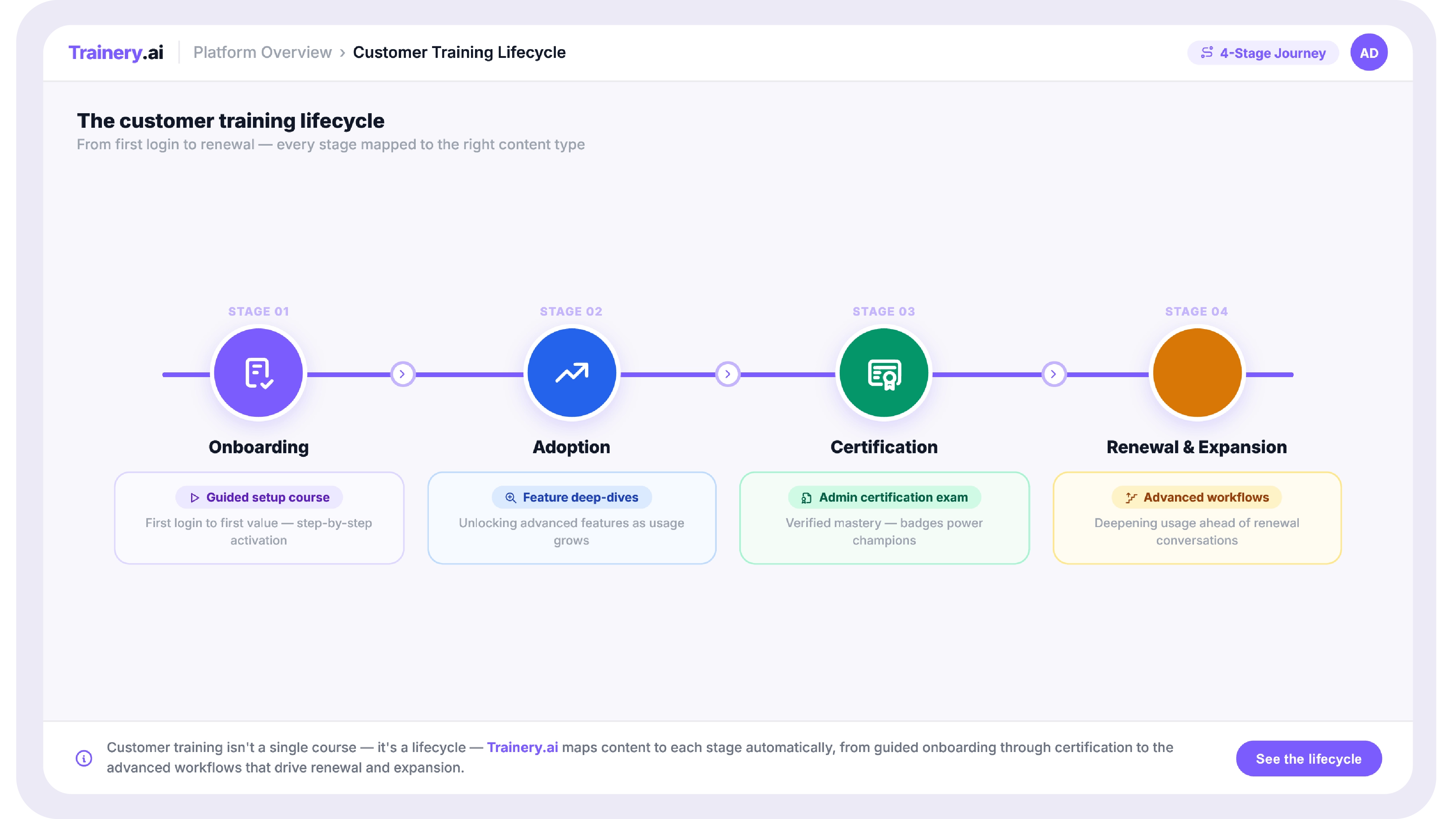
As B2B products add more configuration options, integrations, and use-case-specific workflows, a static help article can't carry the load of getting a new customer to proficiency. Structured onboarding, sequenced, trackable, with checkpoints, does a measurably better job, and that's exactly the kind of learning experience L&D teams already know how to design.
Certification has become a retention and expansion lever.
When a customer's team becomes certified on your product, two things tend to happen: they use more of it, and they become harder to displace, because the switching cost now includes retraining their team. Certification programs that used to be reserved for technical products (think: software platforms requiring an "administrator certification") are showing up further down-market, because the retention math works even for mid-sized accounts.
Support cost pressure is pushing education upstream.
Every support ticket that stems from "the customer didn't know this feature existed" or "the customer set this up incorrectly" is a training gap, not a support gap. Organizations that have started measuring this connection, tying support ticket categories back to onboarding completion, often find that investment in structured customer training pays for itself in reduced support load within a couple of quarters.
In real-world implementations
One pattern that shows up repeatedly: the first customer training program an L&D team builds is rarely the highest-impact one. It's usually the most visible one, a flagship onboarding course for new enterprise accounts. The highest-impact program is often a much smaller piece of content addressing the single most common point of confusion in the product, identified by cross-referencing support ticket themes with onboarding drop-off data. Start with the data, not the assumption.
What Customer Training Software Actually Needs to Do
Customer training has a few requirements that differ meaningfully from employee training, even when the underlying instructional design principles are the same.
Frictionless access: no HRIS, often no formal account relationship at signup
A new customer signing up for a product trial shouldn't have to wait for someone to manually create their training account. Self-registration, ideally triggered automatically from product signup or a CRM event, is table stakes. The training platform needs to be reachable without the multi-step provisioning processes that work fine for new employees, but create friction for someone who just wants to learn how to use the thing they signed up for five minutes ago.
Branding that matches the product experience
Customers interacting with a training portal that looks visibly different from the product, different colors, different terminology, and an unfamiliar vendor name in the corner experience a small but real disconnect. The training experience should feel like a continuation of the product, not a side trip to a different company's software.
Completion data that reaches the right internal team
Training completion data for customers is most useful when it reaches customer success and account management, not just L&D. A customer success manager who can see "this account's admin team hasn't completed onboarding three weeks post-signup" has an actionable signal. If that data sits in a training platform that customer success never looks at, the insight is wasted. This is less about a specific integration and more about making sure the reporting question "which accounts are behind on training, and does L&D need to flag this to CS?" has an answer.
Certification that the customer can show off and that means something.
Customer-facing certificates serve a dual purpose: they're a completion record for your internal reporting, and they're often something the customer's employee adds to a LinkedIn profile or shows their own manager as evidence of professional development. This means the certificate needs to look credible, be verifiable (ideally with a link or code that confirms it's genuine), and, where the program has an expiry, be trackable so that lapsed certifications don't quietly become a liability for either party.
Customer Training Software
TraineryOPS is built to manage employee, customer, and partner training from a single connected platform without separate logins, separate vendors, or separate reporting.
Build, Buy, or Extend? The Decision Most Teams Get Wrong
When customer training first lands on L&D's desk, the instinct is often to evaluate it as a standalone purchase: "What's the best customer education platform on the market?" This is a reasonable question, but it skips a step that usually changes the answer.
The skipped step is: how much of this content already exists, in some form, for internal use? Product training for new sales hires, support team onboarding on new features, internal certification on product changes, a surprising amount of customer-facing content is a repackaged version of something that already exists for an internal audience.
If your existing LMS can extend that content to an external audience with appropriate branding and access controls, the question becomes "extend what we have" rather than "buy something new." If it can't, the evaluation should include not just dedicated customer education platforms, but LMS platforms with genuine extended enterprise capability, because the alternative, a third tool, with its own content library that drifts out of sync with internal training, creates the maintenance burden described in the extended enterprise overview.
A question worth asking before any purchase
"If we build this content once, can it serve both an internal audience (e.g., new sales hires learning the product) and an external audience (e.g., new customers learning the product), from the same source, with different branding and access?" If the answer from your current platform is no, that's the actual gap, and it's a platform gap, not a content gap.
Measuring What Matters: Beyond Completion Rates
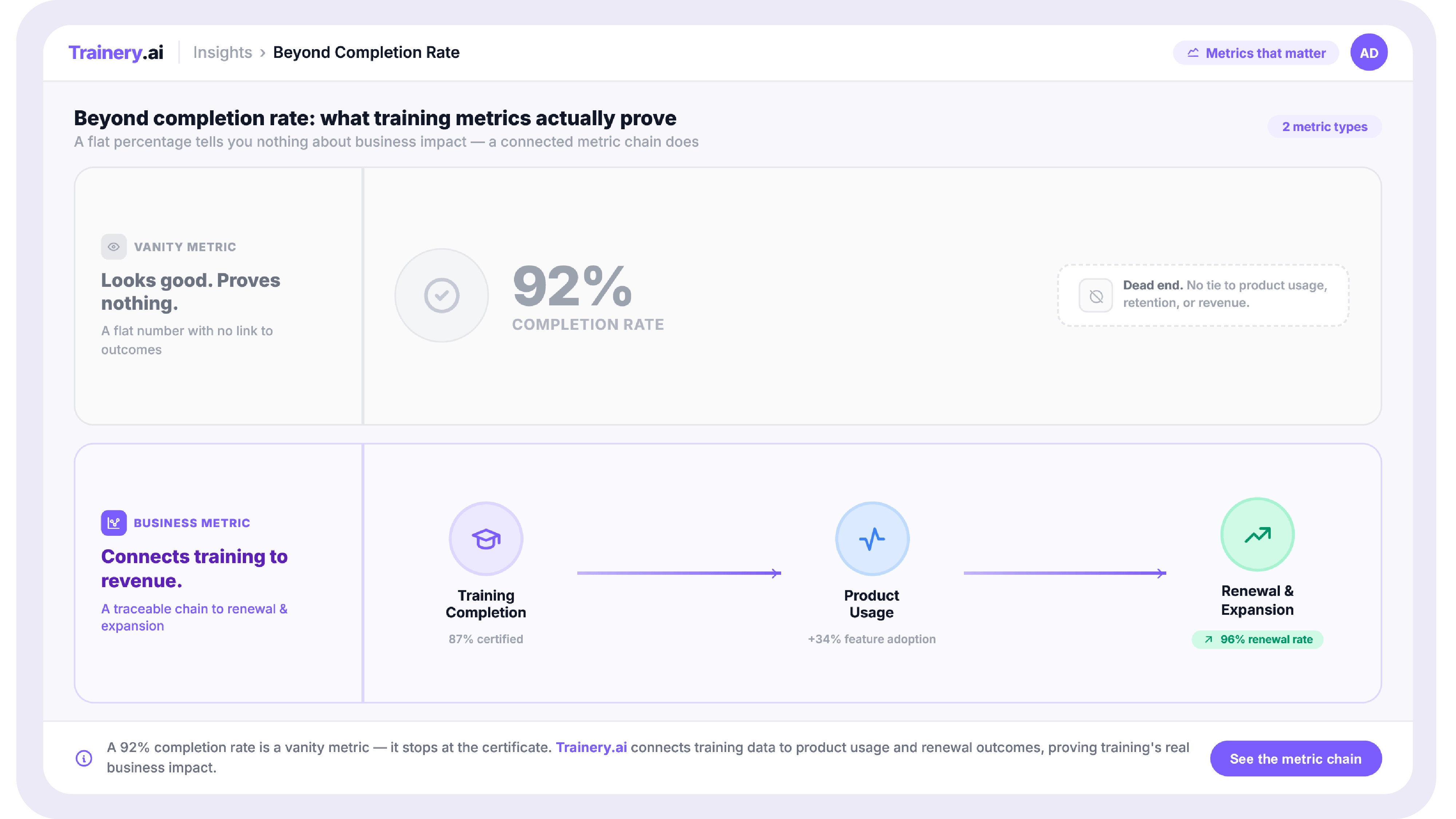
Completion rate is the easiest customer training metric to capture and the least useful one on its own. A 90% completion rate on an onboarding course tells you that people clicked through it; it doesn't tell you whether it changed anything.
The metrics that connect customer training to business outcomes require linking training data to product and account data, which is more work but considerably more useful:
- Time-to-value: how long after training completion does an account reach a defined "activated" usage threshold, compared to accounts that didn't complete training
- Support deflection: change in ticket volume, particularly in categories tied directly to topics covered in training, for trained vs untrained users
- Certification-to-expansion correlation: whether accounts with certified users expand usage or seats at a higher rate than accounts without
- Renewal correlation: whether completed onboarding or certification correlates with renewal likelihood, particularly for accounts approaching a renewal decision
None of these requires exotic analytics; they require the training platform's completion data to be queryable alongside account data, which is usually a reporting and integration question rather than a training content question.
Getting Started: A Realistic First Program
For L&D teams taking on customer training for the first time, the most common mistake is starting with the most ambitious version: a full certification program with exams, badges, and a public certification directory. That's a strong end state, but it's rarely the right starting point.
A more realistic first step: take the single highest-friction part of customer onboarding, the part that generates the most support tickets, the most "how do I..." questions in the first 30 days, and build one short, structured course around it. Make it self-registered, make it trackable, and measure whether completing it changes the support ticket pattern for that cohort over the following month.
If it works, the case for a broader program and for the platform investment to support it properly makes itself with data rather than projection.
Related Trainery Resources
Continue your planning with these closely related guides and platform resources:
- extended enterprise training guide
- security and data protection
- LMS implementation checklist
- learning paths
Your Existing Content, Extended to Customer Audiences
If customer training has landed on your team's plate and your current tools weren't built for it, see how Trainery extends your existing content to customer audiences.
Book a Demo of TraineryOPS →

![Time to Competency: How to Measure and Reduce Employee Ramp Time [+ Template]](https://cdn.prod.website-files.com/69df883470c17d589ab1ae87/6ab7984c17faebc383cb74bc_time-to-competency.webp)

.svg)

.svg)
.svg)

