

.svg)

“Learning management system” is a broad enough term that it can be hard to picture what one actually does until you see it in context. The software a hospital uses to track nursing licenses looks nothing like the platform a retail chain uses to onboard seasonal staff, even though both are technically an LMS.
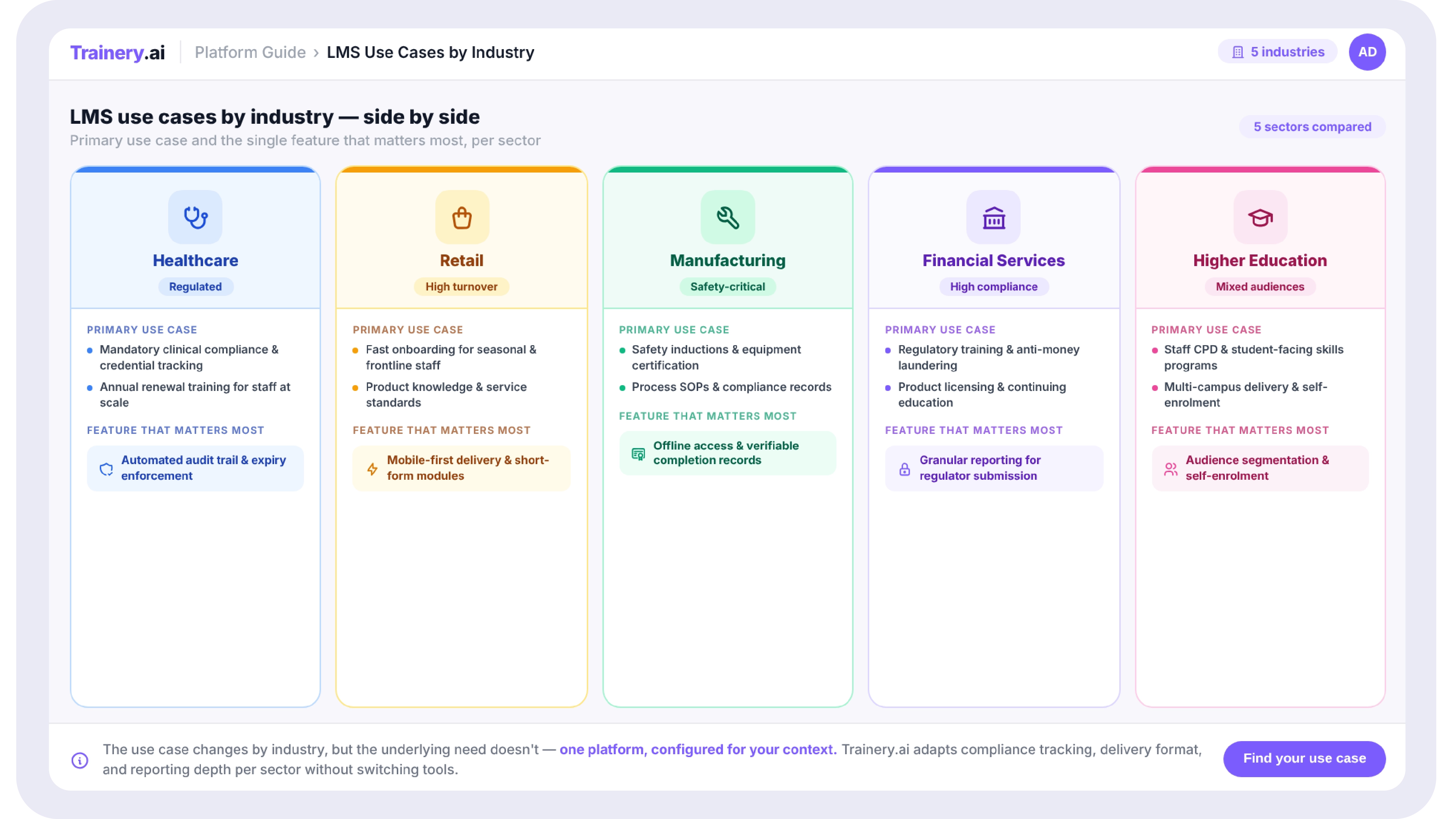
This piece works through ten real-world use cases, organized by industry and by team function, to make the category concrete. Each one covers the specific training problem, what the LMS is actually doing day to day, and the features that matter most for that context.
Two things are worth noting before the list. First, these use cases aren't mutually exclusive. A large retail company, for example, runs both an industry-specific use case (seasonal onboarding) and a team-based one (HR-wide policy training) inside the same platform. Second, the line between “industry” and “team” use cases is really a line between context that's fixed by what the organization does (healthcare, retail, manufacturing) and context that's fixed by what a specific function needs regardless of industry (sales, HR). Most organizations end up combining several of these inside one platform rather than picking just one.
10 Real-World LMS Use Cases by Industry and Team
1. Healthcare: Credential Tracking and Compliance
The challenge: Clinical staff need licenses, certifications, and continuing education tracked with real legal consequences if something lapses. Non-clinical staff need a more standard compliance program running alongside it.
How the LMS is used:
- Tracking nursing licenses, physician credentials, and continuing education with automated renewal alerts
- Delivering HIPAA, OSHA, and infection control training with audit-ready completion records
- Running separate training paths for clinical and non-clinical staff within one system
What matters most: Credential-aware tracking that handles multiple renewal cycle types, not just a generic course-completion model. See how this works in more depth on Trainery's healthcare page.
2. Retail: Seasonal Onboarding and Product Training
The challenge: High turnover, a large part-time and seasonal workforce, and the need to get new hires productive on the floor within days, not weeks.
How the LMS is used:
- Delivering short, mobile-friendly onboarding modules new hires can complete on their own device before their first shift
- Rolling out product training quickly ahead of new launches or seasonal inventory changes
- Tracking completion across many locations from a single dashboard
What matters most: Mobile accessibility and fast content deployment, since a retail LMS that requires a desktop login or a multi-day course defeats the purpose for a workforce that's rarely at a desk.
3. Manufacturing: Safety and Equipment Certification
The challenge: Operating specialized equipment safely requires verified, current certification, and a safety incident tied to a training gap is a serious liability issue.
How the LMS is used:
- Certifying employees on specific equipment before they're cleared to operate it
- Tracking OSHA-mandated safety training with documentation ready for inspection
- Connecting training records to which employees are qualified for which workstations
What matters most: A clear, verifiable link between a person's current certification status and what they're authorized to do, ideally visible on the floor, not just in an admin dashboard.
4. Financial Services: Regulatory and Compliance Training
The challenge: Heavy, frequently updated regulatory requirements, anti-money laundering training, licensing for specific roles, data security, with strict audit and documentation expectations.
How the LMS is used:
- Delivering mandatory compliance training tied to specific roles and licenses
- Maintaining a complete, timestamped audit trail for regulatory examiners
- Updating training content quickly when regulations change, without rebuilding entire courses
What matters most: Audit-ready reporting that can be generated on demand, since regulatory examinations often come with short notice and a specific documentation format expected.
5. Higher Education: Extended and Virtual Learning
The challenge: Delivering coursework to students who may never set foot on campus, alongside training and onboarding for faculty and staff.
How the LMS is used:
- Running fully virtual or hybrid course delivery, including assessments and grading
- Supporting continuing education and professional certificate programs for non-degree learners
- Onboarding and compliance training for faculty and administrative staff, separate from the student-facing platform
What matters most: A platform that can serve two genuinely different audiences, students taking courses and staff completing internal training, without forcing both into the same experience.
6. Nonprofit: Volunteer Training and Coordination
The challenge: Training a workforce that's often unpaid, part-time, and geographically distributed, frequently with limited budget for a dedicated training platform.
How the LMS is used:
- Delivering standardized onboarding and safety training to volunteers before their first shift
- Tracking required certifications for volunteers in regulated roles, such as those working with vulnerable populations
- Managing recurring refresher training without requiring volunteers to travel to a central location
What matters most: Affordability and ease of use, since nonprofits often don't have a dedicated L&D administrator and need a platform volunteers can navigate with minimal instruction.
7. Government: Mandatory and Security-Related Training
The challenge: Strict documentation requirements, training tied to security clearances or specific job classifications, and the need for detailed audit logs across departments.
How the LMS is used:
- Delivering mandatory ethics, security, and procedural training tracked by department and role
- Maintaining detailed records of who completed what, when, for oversight and reporting purposes
- Supporting both civilian and specialized personnel with different training requirements in one system
What matters most: Strong role-based access control and detailed audit logging, since government training records are frequently subject to formal review.
8. Hospitality: Multi-Location Service Consistency
The challenge: Delivering a consistent guest experience across many locations, often staffed by a young, high-turnover, frequently part-time workforce.
How the LMS is used:
- Standardizing service and brand training across every property or location
- Onboarding new hires quickly during peak hiring seasons
- Tracking food safety and other regulatory certifications by location
What matters most: Consistency at scale, the same training experience and standard whether a new hire starts at the flagship location or a newly opened site across the country.
9. Sales Teams: Onboarding and Continuous Coaching
The challenge: New reps need to ramp quickly, and even experienced reps need ongoing reinforcement as products, pricing, and competitive positioning change.
How the LMS is used:
- Running structured onboarding paths that get new reps to their first deal faster
- Delivering short, frequent training updates when products or messaging change, rather than a single annual refresh
- Connecting completed training to performance data, so managers can see whether training correlates with quota attainment
What matters most: A connection between training and actual performance outcomes, since a sales LMS that tracks completion but not impact leaves the most useful question, did this training actually help, unanswered.
Course Done ≠ Skill Gained
Track whether training actually moves performance and quota data — not just completion rates.
10. HR and People Teams: Company-Wide Onboarding and Policy Training
The challenge: Every employee, regardless of department, needs a consistent onboarding experience and ongoing access to company policy and mandatory training.
How the LMS is used:
- Running new-hire onboarding consistently across every department and location
- Delivering company-wide mandatory training, code of conduct, data security, and anti-harassment, with full completion tracking
- Serving as the system HR points to for a defensible, documented training record if a policy question or dispute arises
What matters most: Centralized, defensible records, since HR is often the team that has to produce documentation if a question about training history comes up months or years later.
Common LMS Features Across Most Use Cases
Regardless of industry, most of the use cases above draw on the same core set of LMS capabilities, just weighted differently depending on the context:
- Course delivery and content management, hosting self-paced digital courses, quizzes, and assessments
- Completion tracking and reporting, knowing who finished what, and when, by individual, team, or location
- Certification and renewal tracking, managing credentials with expiry dates and renewal reminders
- Role-based access and training paths, assigning different content to different roles or departments automatically
- Mobile access, letting learners complete training from a phone or tablet, not just a desktop browser
- Integration with HR systems, keeping employee and role data consistent without manual re-entry
- Instructor-led training scheduling, coordinating live sessions, rooms, and instructor availability for the use cases that need it
- Audit-ready documentation, producing a clean, exportable record on demand for inspections, examiners, or internal review
Which of these matters most, and how deep each one needs to go, is exactly what differs across the ten use cases above.
Types of LMS Platforms
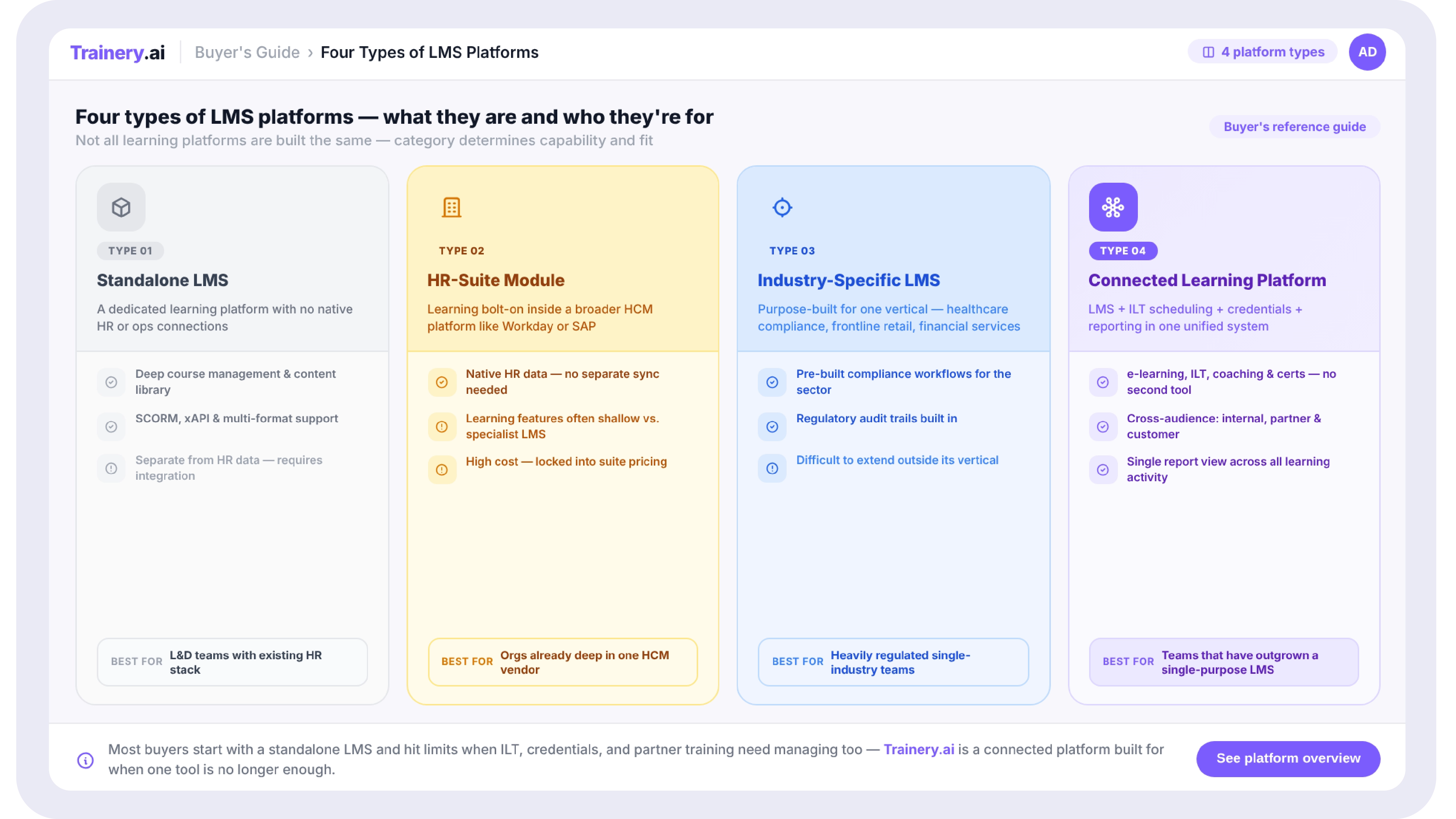
LMS platforms generally fall into a few categories, and the right one depends on whether learning needs to function as a standalone tool or connect to broader HR and workforce data.
Standalone LMS platforms focus specifically on learning, content delivery, and tracking, often with deep features in that single area but limited native connection to performance, compensation, or other HR data.
LMS modules within larger HR suites, such as the learning modules inside Workday or SAP SuccessFactors, come bundled with broader HCM functionality. These can be convenient if an organization is already standardized on that suite, though the learning-specific feature depth is sometimes lighter than a dedicated learning platform.
Industry-specific LMS platforms are built around the compliance and workflow needs of one sector, healthcare or financial services, for example, trading some general flexibility for depth in that specific context.
Connected learning platforms combine LMS functionality, content delivery and tracking, with a training management layer for instructor-led scheduling and a connection to the underlying employee record, so training data ties back to role, performance, and development history rather than existing as an isolated completion log.
How to Choose the Right LMS for Your Organization
A few questions help narrow the type of platform that actually fits, rather than starting from a generic feature checklist:
Does your training mix lean heavily toward self-paced digital content, instructor-led sessions, or a genuine blend of both?
A platform strong in one but weak in the other will leave a gap somewhere in your program.
Do you need industry-specific compliance tracking, or does general-purpose compliance training cover your needs?
Healthcare, financial services, and government typically need the former. Most other industries can usually work with the latter.
Does training data need to connect to performance, development, or compensation data, or can it function as a standalone system?
This determines whether a standalone LMS is enough or whether you need a platform with a connected employee record underneath it.
How many locations, departments, or distinct employee populations need different training paths within one platform?
A single training path that works for one team rarely scales cleanly to ten different roles or locations without that flexibility built in.
What does the vendor's pricing actually include: content library access, certification tracking, instructor-led scheduling, or are those priced as separate add-ons?
This single question often explains more of the real price difference between vendors than the headline per-user rate does.
What Does a Learning Management System Cost?
LMS pricing typically runs on a per-active-user, per-month basis, though the range varies widely depending on what's included.
Entry-level platforms, aimed at small teams with basic course delivery and tracking needs, often start in the low single-digit dollars per user per month.
Mid-market platforms, adding features like certification tracking, role-based paths, and more detailed reporting, typically run higher, often in a moderate per-user range that scales with the number of modules in use.
Enterprise and industry-specific platforms, with deep compliance tracking, instructor-led scheduling, and connected employee record capabilities, generally command the highest per-user pricing, though often with volume discounts at scale.
A more useful comparison than the headline per-user rate is the total cost relative to what's bundled in. A lower sticker price that charges extra for a content library, certification tracking, or instructor-led scheduling can end up costing more in practice than a higher base price that includes all three.
The clearest way to understand what a learning management system does is to look at how it's actually used, not at a generic feature list. A hospital needs credential-aware compliance tracking. A retail chain needs fast, mobile onboarding. A sales team needs training tied to performance outcomes. The category is broad enough to cover all of these, but the right platform for any one organization depends on which of these use cases actually describes its training problem, and whether the underlying system connects that training back to the people doing it, not just to a completion log.
Most organizations will recognize themselves in more than one of the ten use cases above, an industry-specific compliance need alongside a team-based onboarding or coaching need, which is exactly why the strongest platforms are built to handle several of these patterns at once rather than specializing narrowly in just one.
Related Trainery Resources
Continue your planning with these closely related guides and platform resources:
Attendance Tells You Who Showed Up. Not What Changed.
See how a connected platform ties training data to the employee record — so you know whether training closed a skill gap or supported a development goal.
Book a Demo →

![Time to Competency: How to Measure and Reduce Employee Ramp Time [+ Template]](https://cdn.prod.website-files.com/69df883470c17d589ab1ae87/6ab7984c17faebc383cb74bc_time-to-competency.webp)
.svg)

.svg)
.svg)

