

.svg)

Channel partner programs live or die on a question that's easy to state and hard to operationalize: how do you make sure someone who doesn't work for you, sells products from several vendors, including yours, and has every incentive to spend their limited time on whichever vendor is easiest to sell, actually learns your product well enough to sell it correctly?
The honest answer is that training alone doesn't solve this. But training infrastructure that connects to the commercial incentives partners already care about deal registration, MDF (market development funds), co-marketing eligibility, and preferred-partner status turns training from "something else to do" into "the gate I need to get through to access the things I actually want."
This piece covers what a partner training program needs from an LMS to make that connection work, and the specific operational details that separate programs partners actually complete from ones that exist mostly as a compliance checkbox.
Why Partner Training Is Structurally Different From Employee or Customer Training
Partner training sits in an unusual position: the learner doesn't report to you, isn't paying you directly for the training, and has competing priorities from other vendors who are also asking for their time. This changes what "good" looks like.
Tiering is not optional; it's the structure.
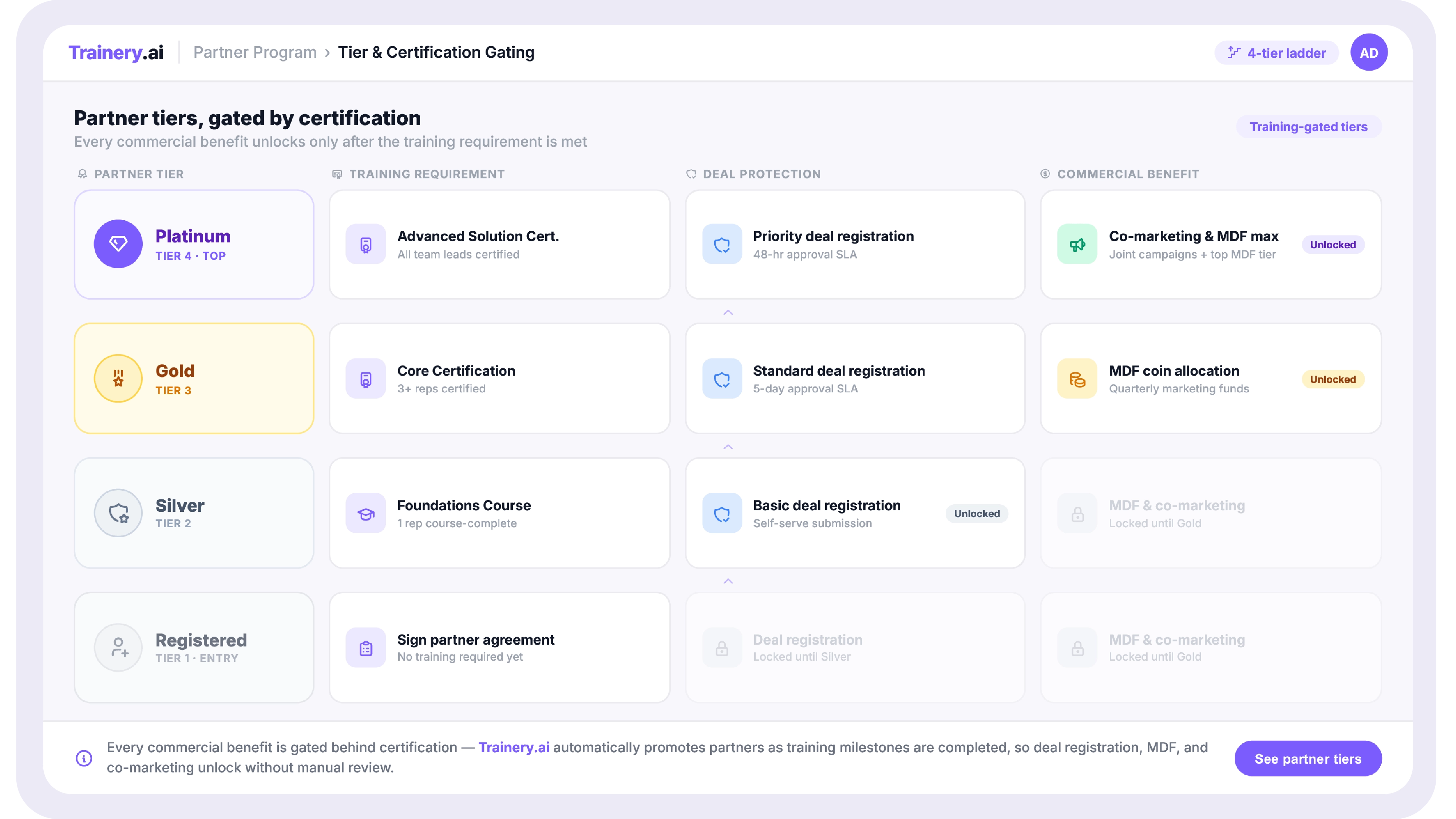
Most channel programs have tiers registered: silver, gold, platinum, or similarly named, and training requirements typically scale with tier. A registered partner might need a single product overview course. A gold partner might need full sales and technical certification across the product line. The LMS needs to support different training paths for different partner tiers, and ideally needs to reflect tier changes automatically when a partner is promoted or demoted, rather than requiring manual reassignment.
Certification needs to gate something the partner wants
The single biggest lever for partner training completion is connecting certification to a commercial benefit. Deal registration, the process by which a partner protects a sales opportunity from being undercut by another partner or by direct sales, is one of the most effective gates, because it's something partners actively want and check regularly. If completing a certification is a prerequisite for deal registration eligibility, completion rates tend to look very different from programs where certification is "encouraged."
Multi-vendor reality means competing for attention.
A partner's sales rep might be certified across five vendors' product lines. Your training needs to be efficient, respecting that this person has finite time and other demands, and ideally needs to fit into however they already organize their multi-vendor learning, rather than requiring a completely separate workflow just for your program.
The Core LMS Requirements for a Partner Program
1. Self-registration with partner verification
Partners need to be able to access training without your team manually creating every account, but you also need some assurance that the person registering is actually affiliated with a partner organization, not a competitor or an unaffiliated individual trying to access partner-only pricing information embedded in training content. The common pattern is invitation-based registration tied to a partner record (often synced from a PRM partner relationship management tool or CRM), or domain-based verification where registration is restricted to email domains matching registered partner companies.
2. Branded, partner-specific portal experience
Partners are, in effect, customers of your channel program even though they're also selling on your behalf. A partner portal that feels purpose-built with your branding, partner-relevant navigation, and content organized around what a partner actually needs (sales tools, certification paths, deal registration links, marketing assets) rather than a generic LMS course cataloge meaningfully affects how seriously partners engage with it.
3. Role-based learning paths within the partner organization
A partner organization isn't one learner; it's a sales team, a technical pre-sales team, sometimes a support team, each of whom needs different training. A sales rep needs positioning and competitive differentiation. A solutions engineer needs technical certification. Treating "the partner" as a single learner profile, rather than recognizing these distinct roles, leads to either over-training (everyone sits through technical certification) or under-training (sales reps never see the technical depth that would help them qualify deals better).
4. Certification with expiry tied to product release cycles
Product certifications that never expire become inaccurate the moment the product changes meaningfully. A partner certified on last year's version may be actively giving customers incorrect information about current capabilities. Tying certification validity to product release cycles and requiring recertification on major releases keeps the credential meaningful, but requires the platform to track expiry and trigger recertification campaigns, which is the same credential-tracking infrastructure used for compliance training, applied to a commercial context.
5. Reporting that connects training status to partner performance
The question channel teams actually want answered is not "what percentage of partners completed training" but "is there a relationship between training completion and partner performance, deal registration volume, win rates, deal size?" Answering this requires training completion data to be queryable alongside whatever system tracks partner performance, typically a PRM or CRM. Without this connection, training data and performance data live in separate silos, and the relationship that channel teams often suspect exists never gets confirmed or used to make the case for program investment.
Partner Training Program
TraineryOPS supports tiered partner portals, role-based certification paths, and credential expiry tracking tied to your product release cycle, connected to the same reporting as the rest of your training programs.
Designing the Certification Path: A Worked Example
To make this concrete, here's how a tiered certification path might be structured for a mid-complexity B2B product with both sales and technical partner roles.
The structure does two things deliberately. First, each tier's requirement builds on the previous one; rather than restarting, a partner moving from Silver to Gold isn't redoing the overview course, they're adding to what they've already completed. Second, every tier's training requirement is paired with something the partner gets in return, which is what turns "complete this training" from an administrative ask into a commercial decision the partner makes for themselves.
| Partner Tier | Sales Role Requirement | Technical Role Requirement | Unlocks |
|---|---|---|---|
| Registered | Product overview course (1 hr) | — | Access to partner portal, basic sales collateral |
| Silver | Product overview + competitive positioning (2.5 hrs total) | Technical fundamentals course (2 hrs) | Deal registration eligibility |
| Gold | Above + advanced use-case selling (4 hrs total) | Above + implementation certification exam | MDF eligibility, co-marketing access |
| Platinum | Above + annual recertification on major releases | Above + annual recertification on major releases | Preferred-partner directory listing, dedicated channel manager |
What Goes Wrong Without This Structure
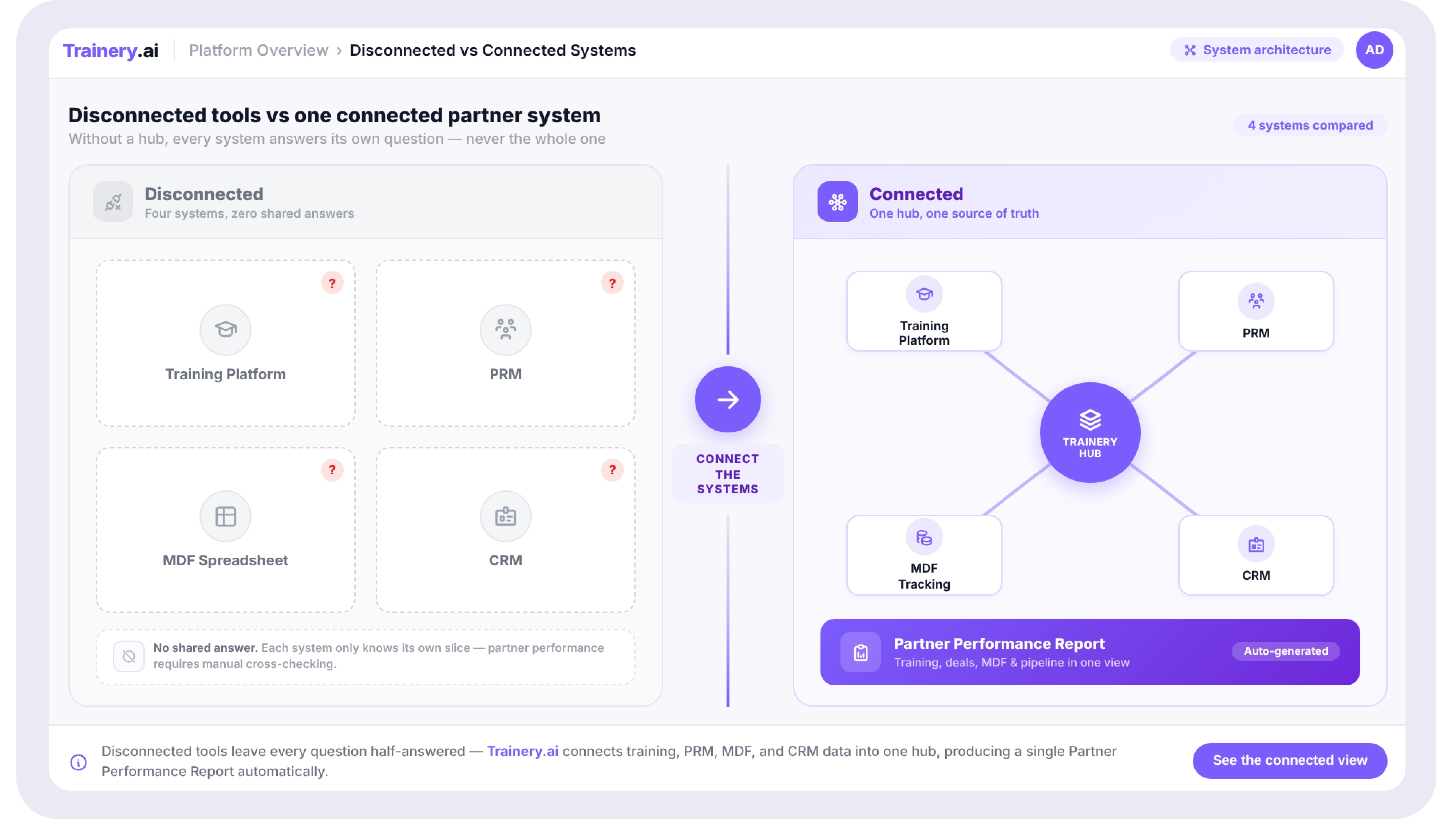
The most common failure pattern in partner training programs isn't bad content; it's a training program that exists structurally separate from the rest of the partner relationship. Training happens in one system. Deal registration happens in the PRM. MDF approval happens through a spreadsheet and an email approval chain. Partner performance data lives in the CRM.
When these systems don't connect, two things tend to happen. Partners complete training because someone asked them to, with no consequence either way for not completing it, so completion rates drift down over time as the "ask" becomes routine and ignorable. And the channel team, asked by leadership whether the training investment is paying off, has no way to answer beyond "completion rate was X%," which says nothing about whether trained partners actually perform differently.
A frequent mistake in partner program design
Building an impressive certification program: exams, badges, a public certified-partner directory without first establishing the connection between certification status and a commercial gate like deal registration. The program launches, completion is decent in the first quarter because it's new, and then steadily declines because partners realize nothing actually depends on it. Establish the gate first; build the content depth second.
Related Trainery Resources
Continue your planning with these closely related guides and platform resources:
- extended enterprise training guide
- customer training software
- platform integrations
- security and data protection
Certification, Deal Registration & MDF — In One System
If your partner certification program exists separately from deal registration, MDF, and partner reporting, see what a connected version looks like.
Book a Demo of TraineryOPS →

![Time to Competency: How to Measure and Reduce Employee Ramp Time [+ Template]](https://cdn.prod.website-files.com/69df883470c17d589ab1ae87/6ab7984c17faebc383cb74bc_time-to-competency.webp)

.svg)

.svg)
.svg)

