

.svg)
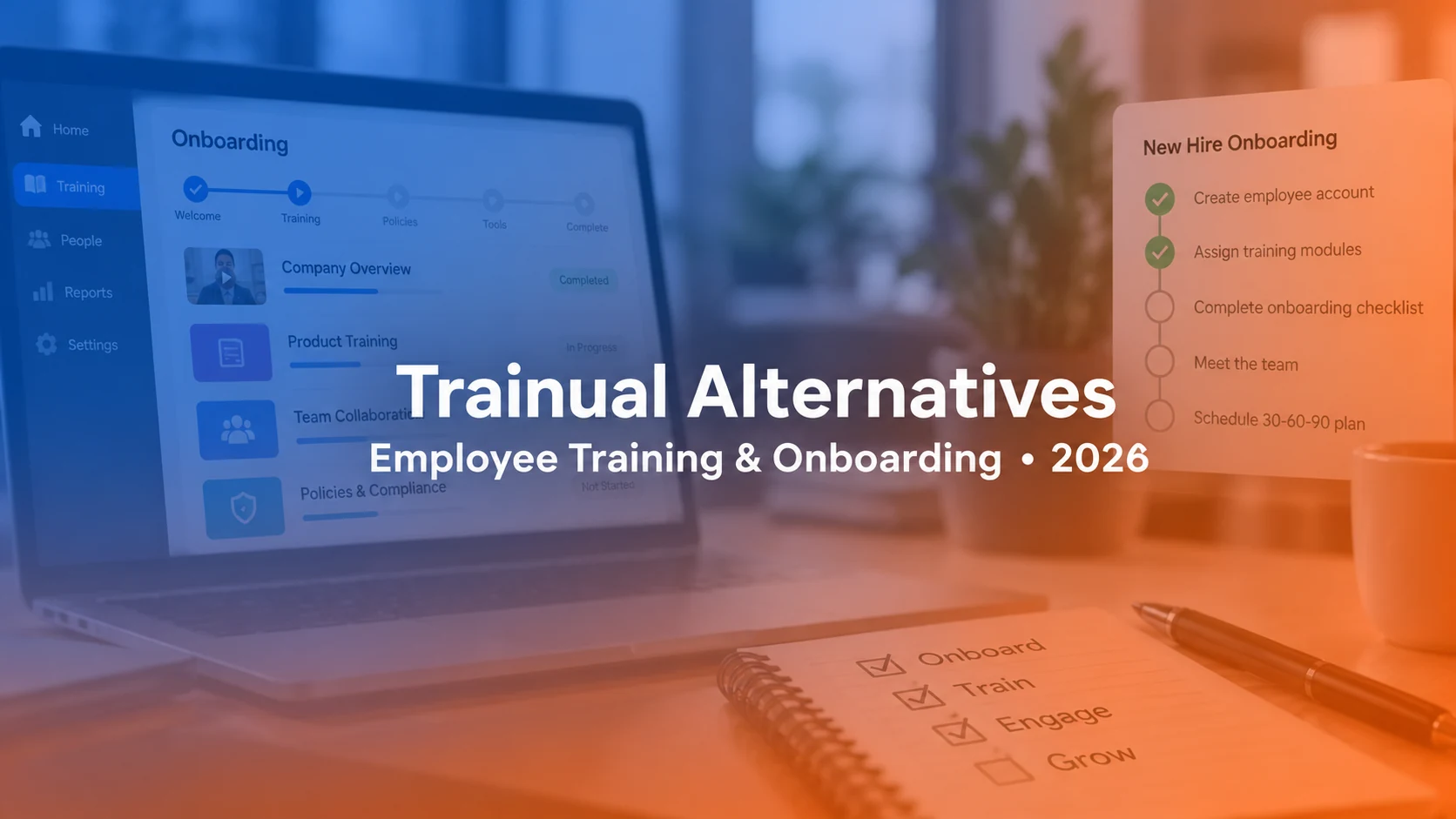

Trainual alternatives become relevant when employee onboarding and SOP training are no longer the only requirements. Trainual remains strong for documenting processes, policies, roles, and team knowledge, then turning that material into role-based onboarding and training. In 2026, it also expanded beyond its original training/documentation model with a separate Operations suite for meetings, goals, scorecards, updates, and day-to-day execution.
That matters when building a shortlist: replacing Trainual is not automatically an LMS project. If the business mainly needs SOP training software, searchable knowledge, policy acknowledgment, and operational alignment, Trainual may still be the simpler fit. Dedicated employee training software or an onboarding LMS becomes more relevant when the requirement expands into formal learning standards, recurring certifications, ILT/VILT, deeper compliance evidence, multi-audience training, enterprise reporting, or more complex learning integrations.
This 2026 comparison is designed for L&D, HR, operations, IT, and procurement teams. Trainery.ai publishes the guide and Trainery appears first, so that commercial relationship is disclosed. Public vendor documentation was reviewed on September 26, 2026. Use the comparison as a research starting point and validate package scope, workflows, migration, security, and contractual commitments in a scripted demonstration.
What Trainual still does well in 2026
Trainual's Training suite remains centered on process documentation and SOPs, onboarding and training paths, knowledge search, testing, tracking and reporting, roles and responsibilities, and organizational accountability. Its 2026 Operations suite adds meetings, goals, scorecards, updates, and AI-supported operational insights. See Trainual Training Suite and the 2026 Operations suite announcement.
That broader scope means a buyer should identify the actual replacement problem before comparing products. An LMS can be a better learning system while still being a weaker substitute for a process playbook or operational-management workflow.
How we evaluated Trainual alternatives
We compared the alternatives against the workflows that determine whether an onboarding and employee-training system remains manageable after the business grows beyond an SOP-first model.
For a structured procurement process, pair these criteria with the LMS vendor evaluation and RFP guide, LMS security checklist, and LMS migration checklist.
10 Trainual alternatives at a glance
| Platform | Best-fit scenario | Main reason to evaluate | Demo question |
|---|---|---|---|
| Trainery | Enterprise learning and training operations | LMS, ILT/VILT, certifications, learning paths, reporting, and connected training operations | Can one role change update learning, live training, credentials, and reporting without manual reconciliation? |
| TalentLMS | SMB and mid-market onboarding LMS | Role-based onboarding, learning paths, certifications, automation, blended learning, and HR connectivity | How quickly can role-specific onboarding be launched and maintained across teams or locations? |
| 360Learning | Collaborative learning and SME-led content | AI-assisted authoring, learning paths, collaborative expertise, automation, and HRIS connections | How do subject-matter experts create and update onboarding content while L&D keeps governance? |
| LearnUpon | Employee plus external-audience learning | Portals, skills, AI authoring, learning journeys, reporting, and centralized administration | How does your 2026 delivery model handle any live-training requirements now that portal ILT management has been removed? |
| Docebo | Complex enterprise onboarding and learning | Automation, personalized onboarding, analytics, integrations, live-session connectivity, and multiple audiences | How does a role or HRIS change alter the learner's required onboarding journey? |
| Absorb LMS | Enterprise LMS administration and reporting | Scheduled enrollments, online courses, curricula, instructor-led courses, reporting, and integrations | Can onboarding milestones be scheduled automatically and reported without manual follow-up? |
| Litmos | Compliance-heavy employee training | Automated compliance workflows, certification renewals, reminders, onboarding, and audit-ready records | Can the platform show the full history of recurring onboarding or compliance requirements? |
| iSpring LMS | Authoring-led onboarding teams | Tight connection between course creation, assessments, onboarding content, and LMS delivery | How do course revisions affect existing completions, reassignment, and historical records? |
| Connecteam | Frontline and deskless onboarding | Mobile training, onboarding flows, quizzes, documents, e-signatures, and workforce operations | Can a deskless new hire complete onboarding, documents, training, and manager checkpoints entirely from a phone? |
| Moodle Workplace | Organizations prioritizing configurability | Programs, recurring certifications, dynamic rules, multi-tenancy, plugins, and deployment flexibility | Which onboarding requirements are native, configured, plugin-dependent, partner-delivered, or custom? |
1. Trainery: for connected enterprise training operations
TraineryLMS is relevant when onboarding has grown into a broader training operating model. It can connect role-based learning paths with ILT/VILT operations, certification tracking, compliance workflows, assessments, reporting, and external-audience training.
Best fit: organizations that need digital learning, live training, recurring credentials, role-based development, and training records to work together.
What to test: create one new-hire path, include a live session and certification milestone, then change the learner's role. Inspect assignments, retained history, manager visibility, notifications, attendance, and credential status.
2. TalentLMS: for teams moving from SOP onboarding to a conventional LMS
TalentLMS has a dedicated onboarding product focused on role-specific learning paths, automated assignments and reminders, certifications, groups and branches, HR connectivity, and faster deployment. Its 2026 releases also expanded skills, learning-path administration, manager visibility, Workday connectivity, and AI-supported learning. See TalentLMS Onboarding Training.
Best fit: small and mid-market organizations that want a recognizable LMS model with strong onboarding automation and relatively straightforward administration.
What to test: reproduce the same SOP-based onboarding content you use today, then add learning paths, certification, a manager view, and a branch or location-specific variation. Compare authoring/update speed as well as LMS depth.
3. 360Learning: for collaborative onboarding content
360Learning positions itself as an AI-driven collaborative LMS that lets internal subject-matter experts contribute to training while L&D maintains oversight. Its current platform includes employee onboarding, learning paths, compliance automation, mobile learning, HRIS integrations, and AI-assisted authoring. See 360Learning.
Best fit: organizations where onboarding knowledge is distributed across managers and subject-matter experts and a central L&D team cannot author or maintain every program alone.
What to test: turn one changing SOP into governed onboarding content. Demonstrate request, SME contribution, review, approval, assignment, learner feedback, update, and retirement—not only the course editor.
4. LearnUpon: for employee plus external training
LearnUpon supports employees and external audiences through portals and, in 2026, added Skills and a broader Agentic Learning Platform direction. It also embedded Create+ for AI-assisted content authoring. One important change for buyers: LearnUpon removed native ILT session management from portals on April 14, 2026, so organizations with live-training requirements should validate the current delivery and integration model rather than relying on older feature comparisons. See LearnUpon's March 2026 update and Agentic Learning Platform announcement.
Best fit: organizations that need centralized administration across employee, customer, partner, or other learning audiences and do not assume the previous native ILT workflow still applies.
What to test: reuse one onboarding curriculum across two audiences, change assignment and reporting rules, then demonstrate how any live-training requirement is handled in the proposed 2026 architecture.
5. Docebo: for complex enterprise onboarding
Docebo's employee-onboarding solution emphasizes automated enrollment and tracking, personalized onboarding journeys, analytics, HRIS and SSO connectivity, and integration with live sessions and communication systems. See Docebo Employee Onboarding.
Best fit: larger organizations with complex learner populations, integrations, automation requirements, and enterprise learning governance.
What to test: sync a new hire from the HRIS, assign a role-based journey, change the role after partial completion, and show exactly what changes in requirements, recommendations, reports, and historical records.
Test the role change that usually breaks onboarding workflows.
Bring one new-hire path, a manager checkpoint, a live session, a certification rule, and a role change. Trainery can demonstrate what updates automatically and what history is retained.
6. Absorb LMS: for structured enterprise administration and reporting
Absorb supports online courses, curricula, instructor-led courses, reports, integrations, enrollment rules, and scheduled enrollments that can automate access to onboarding milestones. Its 2026 product updates also expanded instructor-led course administration and API capabilities. See Absorb Scheduled Enrollments.
Best fit: organizations that prioritize formal LMS administration, structured course delivery, reporting, and live-training support over SOP-centric knowledge management.
What to test: schedule onboarding content by milestone, add one instructor-led session, change the learner's department, and reproduce the manager and compliance reports used after the first 30, 60, and 90 days.
7. Litmos: for compliance-heavy onboarding
Litmos emphasizes automated compliance workflows, recurring certification renewals, reminders to learners and managers, onboarding, and audit-ready training records. See Litmos Compliance & Risk Reduction.
Best fit: organizations where onboarding includes substantial recurring compliance, certifications, or regulated training evidence.
What to test: configure the complete cycle from onboarding assignment through expiration and renewal. Include an overdue learner, a manager escalation, a corrected record, and an audit export.
8. iSpring LMS: for authoring-led onboarding teams
iSpring Learn was renamed iSpring LMS in late 2025. The platform remains closely connected to iSpring's authoring ecosystem, while iSpring Suite supports onboarding course creation with PowerPoint-based authoring, assessments, simulations, localization, and publishing to common eLearning formats. See iSpring LMS naming update and iSpring onboarding authoring.
Best fit: internal training teams that create a high volume of structured onboarding courses and want authoring and LMS delivery tightly connected.
What to test: revise a completed onboarding course and verify version handling, learner history, reassignment, assessments, and reporting. If SOP reference content must remain continuously searchable, test that separately from course authoring.
9. Connecteam: for frontline and deskless onboarding
Connecteam approaches onboarding as part of a broader mobile workforce platform. Its HR tools include onboarding processes, training courses, quizzes, documents, e-signatures, mobile completion, and manager tracking. See Connecteam HR & People Management.
Best fit: frontline, field, retail, hospitality, construction, and other deskless teams that need training close to everyday workforce operations.
What to test: complete the entire new-hire experience on the device employees actually use. Include forms/documents, training, quiz, acknowledgment, manager review, and a required refresher after onboarding.
10. Moodle Workplace: for configurable enterprise learning
Moodle Workplace builds on Moodle LMS with workplace-specific capabilities including Programs, recurring Certifications, Dynamic Rules, multi-tenancy, reports, and reuse of content across tenants. See Moodle Workplace features.
Best fit: organizations prepared to make more implementation, hosting, partner, plugin, and governance choices in exchange for flexibility.
What to test: map each requirement as native, configured, plugin-dependent, partner-delivered, custom, or unavailable. Include hosting, upgrades, security ownership, support, and internal administration in the cost model.
When should you replace Trainual?
Replacing a working Trainual setup only makes sense when the operating requirement has materially changed. In 2026, that decision also needs to account for Trainual's Operations suite—not just its Training suite.
Keep Trainual central when…
SOPs, policies, searchable team knowledge, role expectations, onboarding paths, tests, and day-to-day operational alignment are the core problem—and the Training plus Operations suites fit the way your managers work.
Evaluate a dedicated LMS when…
Formal course standards, recurring certifications, complex compliance evidence, ILT/VILT operations, multiple learning audiences, deeper learning analytics, or enterprise training integrations have become primary requirements.
If the main goal is to build a structured onboarding program rather than select software, use Trainery's employee onboarding training program guide. If your current onboarding relies heavily on live sessions, also review the training management systems comparison.
Trainual alternative evaluation checklist
Use the same scenario and evidence standard for every finalist so a polished demo does not hide operating complexity.
If migration is likely, test a real sample using the LMS migration checklist. If security or SSO is a gating requirement, use the LMS security checklist before final selection.
Use one onboarding and role-change scenario for every vendor
Create a new hire in Role A with a three-stage onboarding path. Include one policy acknowledgment, one SOP/reference item, two digital courses, one assessment, one live session, and one certification or recurring requirement. Let the learner complete part of the path, then move them to Role B.
Require each vendor to show what remains, what is withdrawn, what is newly assigned, what happens to prior completions, how the manager is notified, whether live-training records remain connected, and what historical evidence the administrator can export. This scenario reveals more than a generic feature checklist.
Final selection guidance
The right Trainual alternative depends on what has become more important than Trainual's strengths in process documentation, role-based onboarding, team knowledge, and operational alignment. TalentLMS fits teams moving toward a conventional onboarding LMS. 360Learning fits collaborative knowledge creation. LearnUpon fits multi-audience learning but requires careful validation of the current live-training model. Docebo and Absorb fit more complex enterprise learning. Litmos fits compliance-heavy environments. iSpring LMS fits authoring-led teams. Connecteam fits deskless workforces. Moodle Workplace fits organizations prioritizing configurability.
Trainery is most relevant when the replacement requirement spans digital learning, ILT/VILT, certifications, learning paths, reporting, and broader training operations. Because Trainery.ai publishes this comparison, validate Trainery with the same scripted scenario, evidence standard, security review, and commercial scrutiny applied to every other finalist.
Compare Your Current Trainual Workflow Against a Full Training Operating Model
See how role-based onboarding, digital learning, ILT/VILT, certifications, manager reporting, and historical training records can work together without losing the process context your team depends on.
Book a Demo

.svg)

.svg)
.svg)

