
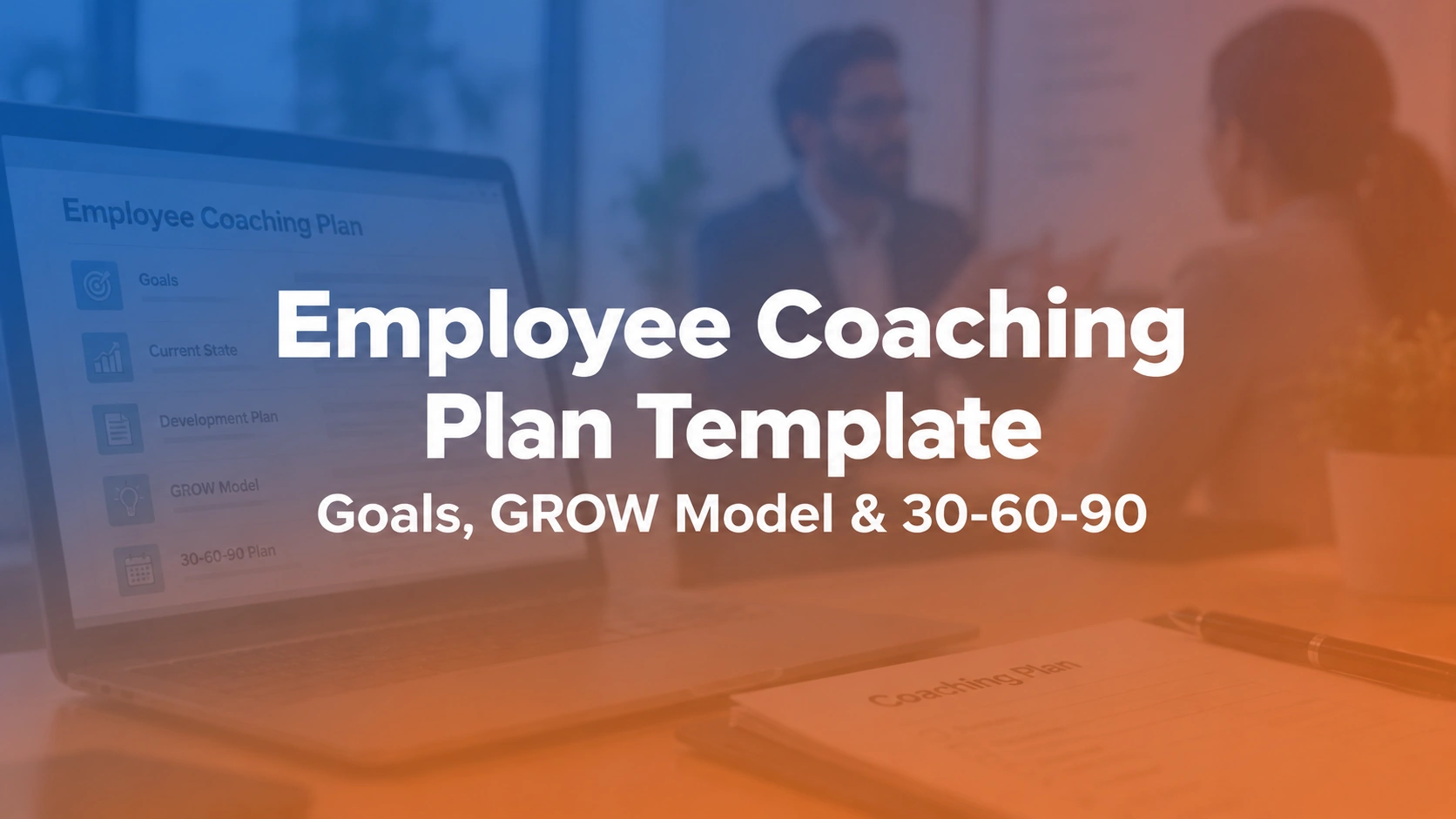

An employee coaching plan is a shared working agreement that defines the coachee's development goal, starting point, chosen actions, review dates and evidence of progress. The GROW framework organizes the conversation into Goal, Reality, Options and Will or Way Forward. A 30-60-90 day follow-up adds a cadence, but the plan remains flexible: coaching is not a script or an automatic employee performance rating.
Use this guide to build a plan with your employee, not simply for them. The examples are fictional and show how to turn broad development goals into realistic actions. When several people need to coordinate coaching schedules and milestones, TraineryCoaching provides related program-management context; use the worksheet to agree on the goal and evidence first.
What does an employee coaching plan look like?
A usable coaching plan identifies one development goal, the current situation, agreed practice activities, support needed, and how progress will be reviewed. The example below follows a fictional employee learning to run project handoffs. It is a template to adapt—not an employee performance record or proof that coaching caused a business result.
| Plan field | Example entry | Decision it supports |
|---|---|---|
| Goal | Lead difficult project handoffs confidently | Defines observable success |
| Starting point | Two handoffs required manager intervention | Creates a baseline |
| GROW: Options | Practice opening agenda and escalation question | Supports coachee choice |
| Day 30 | Lead one meeting and collect feedback | Tests early practice |
| Day 60 | Repeat across three projects | Checks consistency |
| Day 90 | Reflect on evidence and plan next steps | Determines continuation |
What should an employee coaching plan contain?
Begin with one specific development aim rather than a long list of weaknesses. Capture who owns the goal, where the learner is starting, the actions they choose, relevant support, follow-up date and the kind of evidence that would demonstrate progress. A coaching plan should be co-created and understood by both parties; it is not merely a document HR emails to a manager.
Workplace example: For an employee learning to delegate, record a target behavior such as assigning outcomes and agreeing checkpoints. 'Become a better leader' is too vague to guide a conversation or evaluate change.
To manage several plans, see employee coaching software and coaching program management. These address program oversight; goals and coaching conversations should remain coachee-centered.
How do you use the GROW model in an employee coaching session?
GROW means Goal, Reality, Options, and Will (or Way Forward). The model was developed by Sir John Whitmore and colleagues and is designed to help the coachee think through a challenge and commit to an action. In practice, a coach can move between stages as new information emerges. Performance Consultants' guide to GROW explains this flexible approach.
For a project handoff problem, start by asking what success would look like (Goal), what currently prevents it (Reality), which changes could help (Options), and which specific step the employee will try before the next meeting (Will). Resist the urge to supply every answer: the employee should influence the choice and own the action.
Roles matter: an employee's manager and an external professional coach may have different disclosure obligations. Compare internal coaching management with external coaching management when setting expectations.
| GROW stage | Useful coaching question | What to write in the plan |
|---|---|---|
| Goal | What will a successful handoff look like? | Agreed behavior and desired result |
| Reality | Where does the current process break down? | Factual starting point and barriers |
| Options | What two approaches could you try? | Choices, support and trade-offs |
| Will / Way Forward | Which action will you take before our next meeting? | One owner, action and check-in date |
How do you write a measurable employee coaching goal?
Choose one behavior the employee can realistically practice, define a starting point, and agree how to recognize progress. A useful goal states the action, situation, and review date without reducing development to a popularity score. Confidence ratings can help reflection, but they are not equivalent to evidence of changed behavior.
Example: Instead of “be more confident with stakeholders,” write: “For the next four project reviews, prepare an agenda, state decisions and owners, and ask at least one clarifying question when a requirement is disputed.” Review real meeting examples together at days 30 and 60. Four meetings is an illustrative practice target, not an established benchmark.
To track owner and progress without overcollecting notes, review coach and coachee management and engagement management.
Days 1–30: agree on the goal and test a first action
Begin with a coaching agreement: what the person wants to develop, who is involved, how often they will meet, and what information may be shared with a sponsor. Agree on a baseline using work examples rather than an invented score. Choose one manageable action and practice it before the first review. Suggested checkpoint: Can the employee describe what they tried and what happened?
Example: A new team lead prepares an agenda for one handoff meeting, states ownership of each task and asks a colleague for feedback. The coach and employee reflect on the meeting without automatically passing private notes to HR.
Follow-up dates and brief milestone status can support oversight. The coaching session tracking and analytics pages provide context, but privacy boundaries must be established before data is shared.
Ask to see an employee goal change, coach reassignment, sponsor view and privacy control in Trainery's program workflow.
Days 31–60: repeat the behavior and address obstacles
Review how the first action worked, then practice in a second situation. Ask what the employee learned, which barriers are within their control, and which require manager or process support. Revise the action if it is not useful; a 60-day checkpoint is a planning convention, not a deadline by which every employee must improve.
Example: The team lead runs handoffs for two different projects. One goes smoothly, but an urgent escalation exposes unclear decision rights. The next coaching action may be to agree an escalation rule—not to label the employee unsuccessful.
For related development situations, see the manager coaching program guide and leadership coaching guide. A repeat practice step matters more than a perfect-looking dashboard.
Days 61–90: review progress and decide what comes next
Compare the agreed goal with specific work examples and feedback the employee agreed to collect. Record what improved, what remains difficult and what support is still missing. Choose to close, extend or redirect the coaching plan. A day-90 conversation should include the employee's perspective, and it must not silently become a formal performance evaluation.
Example: After several project reviews, the employee reliably confirms task ownership but still needs support with high-stakes disagreements. Close the handoff goal and create a separate practice objective for conflict management if both parties agree. The examples do not establish that coaching alone caused the improvement.
Explore the distinction between a single engagement and broader development support in employee coaching software and employee development programs.
Is employee coaching the same as a performance improvement plan?
No. A development-focused coaching plan helps an employee explore a goal, practice behaviors and reflect on progress. A formal performance improvement plan (PIP), where used, is an employer-managed performance process with its own expectations and consequences. Do not imply that a confidential coaching conversation is automatically part of a personnel assessment. The CIPD coaching and mentoring factsheet emphasizes choosing coaching only when it suits the development need and clarifying boundaries in manager-led relationships. State the purpose, decision-maker and information-sharing rules before an engagement starts.
How do you protect privacy in the coaching plan?
Agree who can see the plan, what progress information may go to a manager or sponsor and which session content remains private. Professional coaching standards emphasize confidentiality and sponsor agreements. For internal manager-led coaching, explain the different reporting relationship clearly at the outset.
Workplace example: A sponsor may legitimately need attendance, participation and agreed business goals, but not every personal concern raised during a session. Keep the detailed conversation record access-limited and do not collect more than necessary.
The ICF Code of Ethics calls for clarity about roles, confidentiality, sponsor information-sharing and secure handling of records. Its professional duties apply to ICF professionals; organizations should define their own legally appropriate policies for managers and internal coaches.
For role-specific development, a skills gap analysis or skills matrix may help identify a suitable goal; neither justifies disclosing private coaching notes.
When should teams use coaching management software?
A document is enough for a small program if the people involved understand ownership and privacy. A system helps when several coaches and coachees need consistent scheduling, milestones and appropriately restricted reporting. Evaluate whether sponsors see only agreed information and whether sensitive notes can be separated from operational data.
Workplace example: Ask the vendor to show an external coach changing dates, a sponsor requesting a summary, and a coachee closing the relationship early. Good software must handle the access and records left behind.
Use competency-based training and training needs analysis to decide when instruction or process changes could help more than coaching alone.
How to use the free employee coaching plan Excel template
Use the workbook linked above as a practical working document, not a substitute for the coaching conversation. Agree on which fields the employee, coach and sponsor may see before entering personal information.
- Set the goal: choose one observable behavior and a realistic review date.
- Describe the starting point: add factual examples and strengths, not general judgments about personality.
- Use GROW: capture the Goal, current Reality, possible Options and one agreed Will/Way Forward action.
- Define milestones: choose what to try by days 30, 60 and 90, adjusting dates to the employee's situation.
- Record evidence: keep brief examples of actions attempted and outcomes observed; mark missing evidence as unknown.
- Agree on sharing: separate sponsor-visible status from private coaching notes and review who can access the file.
- Review together: use each checkpoint to adjust the action, not simply to score the person.
A spreadsheet is enough for a small, well-governed engagement. When many coaching relationships require reminders, appropriate access controls and reporting, compare the administration effort with a dedicated program workflow.
Questions to ask before you select software or a coach
- Can the program owner explain the goal and evidence required?
- Can participants understand the boundaries of confidentiality before the first session?
- Can a coach change a session or engagement without exposing private notes?
- Is access limited by role, and is the offboarding process documented?
- Are outcomes and expenses measured with visible assumptions?
- Does the reporting avoid turning subjective feedback into unsupported financial claims?
These questions are aligned with practical guidance on professional coaching relationships. For confidentiality and sponsor agreements see the ICF Code of Ethics. Where HR is evaluating management capability, the CIPD coaching and mentoring factsheet also discusses boundaries and organizational context.
Example coaching conversation: convert a vague goal into action
An employee says, 'I want to become more confident in meetings.' Rather than adding 'confidence' as the only coaching KPI, the coach asks what specific situation is difficult and what a successful meeting would look like. The coachee identifies that they avoid asking clarifying questions when stakeholders disagree. In the Reality stage, they recall two recent examples. In Options, they propose preparing three questions before each planning meeting, rehearsing an opening statement and requesting feedback afterward. The Will stage ends with one agreed action and a date, not an abstract promise to improve. At day 30, review whether the person tried the questions. At day 60, discuss several meetings and obstacles. At day 90, examine changes in their participation and decide whether to revise the plan. The sponsor may receive an agreed progress summary; the coach should not automatically disclose the private discussion. The approach makes GROW practical while preserving the coachee's autonomy.
Conclusion: make coaching practical and respectful
The best employee coaching plan is one the employee and coach can use between conversations. Start with a meaningful goal, use GROW to explore choices, agree on manageable practice and review evidence at 30, 60 and 90 days—or another cadence that fits. Protect the confidentiality of the relationship and avoid turning developmental coaching into an unannounced performance rating. Download the Excel template to begin; if your organization coordinates many engagements, review the TraineryCoaching workflows and ask for a demonstration using a realistic, anonymized case.
Review Trainery's coaching program and engagement workflows with your HR team. Bring an anonymized development plan and ask how the system handles confidentiality, scheduling, milestones and reporting.
Book a Trainery DemoDownload your workbook
Enter your name and work email to unlock the Excel file.