
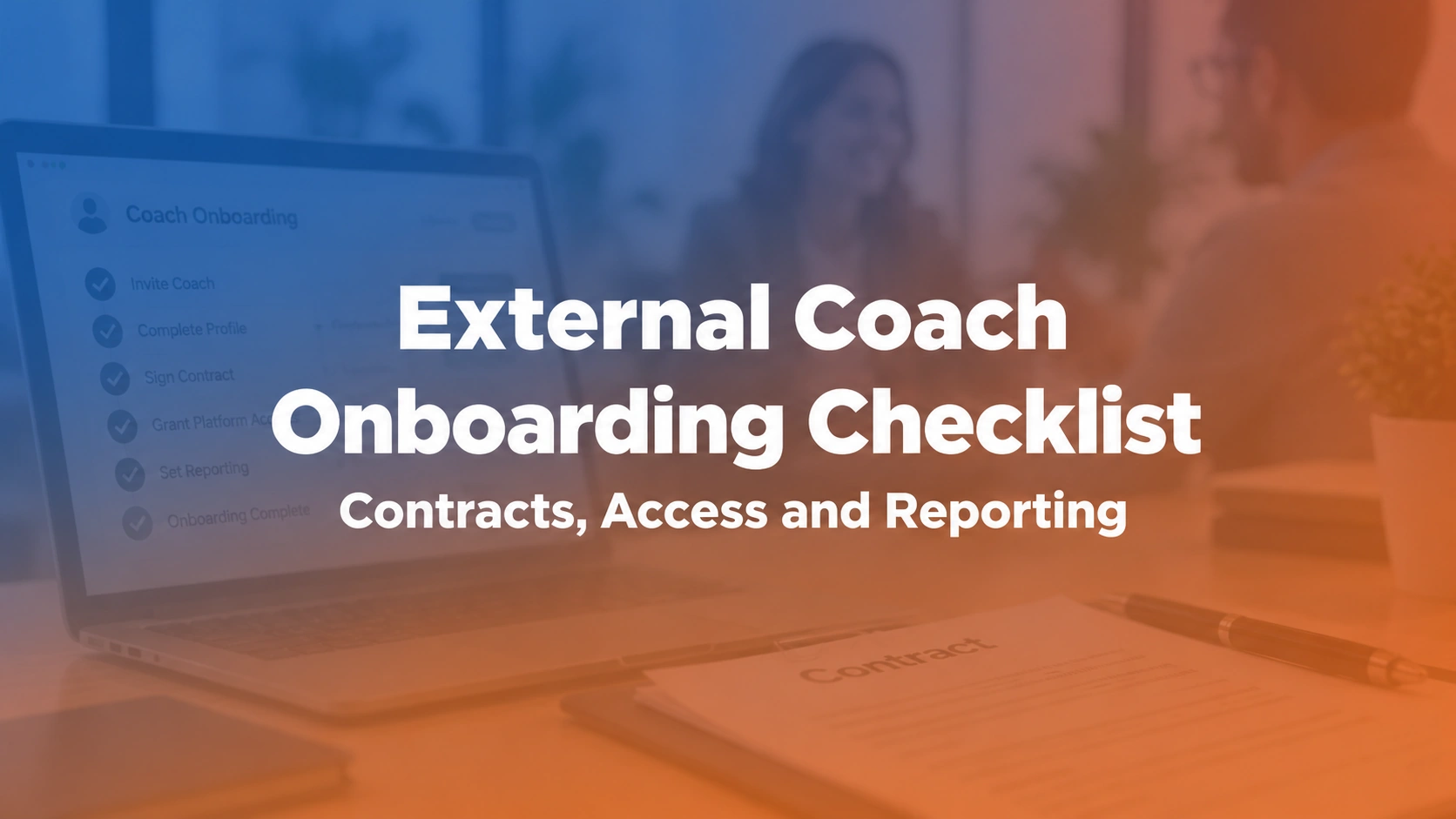

External coach onboarding is the process HR uses to prepare an outside coach to work with employees. A practical checklist covers vetting, contract terms, the three-party coaching agreement, confidentiality, limited system access, matching, scheduling, sponsor reporting and offboarding. Complete these checks before the first session: a signed purchase order alone does not establish safe access or clear expectations.
The checklist below is designed for HR, L&D and coaching program owners coordinating external facilitators. The scenarios are illustrative—not customer outcomes or a substitute for legal, procurement or privacy review. For teams managing multiple coaches, Trainery's employee coaching software provides context on program administration; establish the agreements and permissions before deciding how to track them.
External coach onboarding checklist: seven checkpoints
Give every stage a named owner and a verifiable completion record. HR may coordinate the process, but procurement, legal, IT, the coach and the coachee have different responsibilities. Treat this table as a starting checklist, not as proof that every step has been performed.
| Onboarding phase | Required confirmation | Evidence |
|---|---|---|
| Sourcing | Qualification and scope verified | Approved coach record |
| Contracting | Fees, cancellation and responsibilities | Signed contract |
| Privacy | Confidentiality and sponsor rules agreed | Coaching agreement |
| Access | Least-privilege access and expiration | Access approval |
| Launch | Coachee match and scheduling | Confirmed kickoff |
| Reporting | Permitted aggregate/progress fields | Reporting schedule |
| Exit | Access revoked and records disposition | Closeout sign-off |
What should HR verify before hiring an external coach?
Start with the role and the intended development outcome: who needs coaching, why an external practitioner is appropriate and whether the engagement is individual, team or group-based. Check relevant coaching education, any claimed credentials, experience with similar goals, availability, references where appropriate and possible conflicts of interest. Independently verify credentials when those credentials are part of the selection criteria. A credential alone cannot establish fit or guarantee outcomes.
Example: A coach experienced in senior leadership transitions may not have the background needed for a technical leadership team. Ask how they would structure an engagement for that team's specific needs, what they would measure and which issues are outside their scope.
For multi-provider programs, coaching program management and internal coaching management illustrate the operational difference between a program-level owner and an internal coach.
What must an external coaching services contract include?
Ask procurement and counsel to review the scope of services, parties, duration, fees, invoicing, rescheduling and cancellation rules, travel expenses where relevant, responsibilities for scheduling, insurance when applicable, information security expectations, record handling, termination and dispute procedures. Requirements depend on the organization and jurisdiction; this is an operational checklist, not legal advice.
Separate two agreements: The commercial contract covers services and payment between the organization and provider. The coaching agreement establishes the relationship among coach, coachee and any sponsor—including goals, boundaries, confidentiality, session arrangements and information sharing. The ICF Code of Ethics (effective April 1, 2025) expressly calls for agreement on these matters before coaching begins for ICF professionals.
Example: If a participant misses a session, the contract should identify the notice requirement, whether a fee applies and who is responsible for rescheduling. Do not infer that the coach may share a private explanation for the absence.
A signed contract does not assign people or grant access. Keep those steps distinct when reviewing external coaching management and coach and coachee management.
What coaching information may HR and the sponsor receive?
Specify the reporting boundary before the first session. Depending on the agreed purpose, HR may need service dates, attendance status, program milestones, billing information and a coachee-approved high-level progress summary. Private coaching conversations are not automatically available to the employer simply because it pays for the program. The current ICF Code of Ethics includes expectations for confidentiality, records and agreements about disclosures, including applicable legal or safety-related exceptions. Those ethics standards apply within the ICF professional context; organizations must also follow applicable law and policy.
Example: If a coachee discusses uncertainty about a promotion, the coach should not send that conversation to the manager as routine reporting. The sponsor can instead receive the limited status or goal-progress information authorized by the agreement. Define the escalation contact and exception process rather than making ad hoc promises.
Define what may be entered into engagement management and coaching session tracking before collecting any employee-level details.
What system access should an external coach receive?
Start with least-privilege access: only the assigned coachees, approved scheduling information and resources necessary to deliver the agreed service. Use an individual account where supported, a clearly defined expiry date, appropriate authentication and an owner for access requests and incidents. Do not provide broad HRIS, compensation, performance-review or talent-planning access by default.
Example: A coach who needs meeting availability and milestone status should not see a complete personnel file. Before launch, ask IT to test the permission set with a representative account, and document who can deactivate access when the coach changes or the contract ends.
Before configuring coaching analytics, define access roles and which metrics can be shared. The manager coaching program guide provides another perspective on coaching responsibilities.
Ask to see an employee goal change, coach reassignment, sponsor view and privacy control in Trainery's program workflow.
| Reporting information | Possible HR approach | Required check |
|---|---|---|
| Session completion and budget use | Operational status for contract administration | Agreed purpose, access and retention |
| Broad goal progress | Only the progress summary agreed among parties | Disclosure terms and employee awareness |
| Private coaching notes | Not routine sponsor reporting | Confidentiality, lawful exceptions |
How should HR match an external coach with an employee?
Match on the agreed coaching goal, relevant expertise, language, availability, time zone, accessibility requirements and conflicts of interest. When feasible, offer the coachee a meaningful choice and a confidential way to request a different coach. A compatible calendar is necessary, but it is not a substitute for trust.
Example: If the employee reports a prior relationship that makes a match uncomfortable, the program owner should offer a confidential reassignment process without broadcasting the reason. CIPD's coaching and mentoring guidance notes the importance of confidentiality, information flows and suitable coaching arrangements.
Match the coaching approach to the actual goal; the leadership coaching guide and employee coaching software guide offer related decision context.
What should happen at the coaching kickoff?
Share the program's purpose, coordinator contact, scheduling rules, meeting technology, accessibility arrangements, expected number of sessions and the help route for a technical or safeguarding concern. Confirm the coachee understands the voluntary or required aspects of participation, the goals, and what the sponsor can and cannot receive. Where appropriate, use a short three-party conversation to agree objectives, then let subsequent coaching sessions remain private within the agreed boundaries.
Example: The HR sponsor explains why leadership coaching is funded; the coach explains confidentiality and ways of working; the employee confirms what they wish to work on. The orientation does not replace a signed coaching agreement or policy review.
Use an existing employee development program or a skills gap analysis to clarify broad goals, but agree on what information the sponsor may receive.
What should an external coaching program report to HR?
Measure whether the service is delivered and whether agreed development milestones are progressing. Useful operational fields include the number of active engagements, sessions completed, no-shows or cancellations, contract utilization, spend against budget, and agreed progress-checkpoint status. Keep individual coaching notes separate from these fields. A small cohort may remain identifiable even after names are removed, so review privacy risks before sharing a departmental report.
Example: For a small leadership-coaching pilot, share the total sessions delivered and aggregate service feedback where it does not reveal individuals. An identifiable progress narrative should only be shared under the agreed arrangements and applicable privacy rules. Do not interpret sessions completed or self-reported confidence as proof of business ROI.
Where the goal concerns job skills, compare the skills matrix guide and competency-based training. Keep coaching service reporting separate from a formal competency assessment.
What is the external coach offboarding checklist?
Close the engagement in two tracks. Service closeout confirms the agreed final session, coachee-approved wrap-up, invoices, remaining contractual obligations and any handover. Security and records closeout confirms access revocation, removal from groups and calendars where appropriate, a documented record-retention or deletion decision, and the person accountable for each step. Follow retention obligations rather than deleting all material automatically.
Example: When a coach's engagement ends, IT should disable their permissions according to the offboarding procedure even if an invoice remains open. If the employee transfers to a new coach, share only the permitted handover information under the agreed process.
A training needs analysis can help determine the next intervention. If the organization also uses learning intelligence reporting, apply its authorization and data-minimization requirements independently.
How to use the free external coach onboarding Excel checklist
Use the workbook above as a readiness register for each coach or engagement. It should make responsibility visible, not store confidential notes. Before sharing the file, decide which teams can edit it and where the authoritative signed agreements and access approvals will be stored.
- Confirm the coach and scope: record provider, intended audience, services, commercial owner and the result of credential or reference checks.
- Record contract approval: note the agreement owner, execution status, session package, payment terms and exit rules; link to approved documents rather than pasting confidential terms into an open tracker.
- Define confidentiality: record whether coach, coachee and sponsor have agreed on goals, reportable information and exception handling.
- Authorize limited access: identify the IT approver, permissions required, start date, expiration date and access-validation result.
- Confirm the match and kickoff: document the assigned coachee, contact route, scheduling owner and whether kickoff expectations have been acknowledged.
- Set reporting and closeout: agree on approved progress fields, report dates, invoice owner and offboarding tasks.
- Review readiness: mark missing approvals as pending rather than presenting a partially prepared coach as cleared to begin.
Before day one: test one routine case and one exception—a sponsor asking for private notes or a coach reassignment—to confirm the documented process works. Have legal, privacy and IT teams review requirements applicable to the organization.
What should HR ask before choosing coaching management software?
Use an anonymized real-world scenario, not a generic features presentation. Ask the vendor to show how HR assigns a coach, restricts coachee access, tracks authorized milestones, replaces a coach, closes a contract and removes an external user. Require the vendor to explain where sensitive notes would live and which people could retrieve them. Compare the workflow with external coaching management, engagement management, and coaching analytics. These links provide product context; the article does not establish that any untested feature is available in a particular configuration.
Onboarding scenario: HR sponsor, coach and participant
Suppose HR commissions coaching for a newly appointed director. The purchase order describes six sessions, but the director believes the coach will report every discussion to their manager. Onboarding must resolve that misunderstanding before the first meeting. The HR sponsor confirms the program's business objective and how engagement status will be reported. The coach explains their independent professional obligations, confidentiality terms and any lawful exceptions. The director can ask questions and agree on the relationship. IT then provides narrowly scoped access to scheduling tools, not the entire personnel system. A program administrator confirms meeting logistics, escalation contacts and the cancellation process. Before launch, the parties test the data-sharing boundary with an example: what would HR receive if the participant asked to change a goal? The correct answer should follow the signed agreement rather than an improvised promise. At closeout, the checklist confirms completed sessions, permitted outcome reporting, account revocation and record disposition. This small rehearsal can prevent much larger trust and privacy problems.
Conclusion: make the coach ready before the first session
External coach onboarding works when HR can answer three questions: Is the coach and agreement approved? Does the coachee understand the boundaries of the relationship? Can the coach work effectively without unnecessary access to employee data? Use the Excel checklist to track those decisions, assign accountable owners and plan offboarding from the start. If your team coordinates multiple providers or coaching engagements, review TraineryCoaching with a real authorization, reassignment and sponsor-reporting scenario—not just a product feature list.
Review Trainery's coaching program and engagement workflows with your HR team. Bring an anonymized development plan and ask how the system handles confidentiality, scheduling, milestones and reporting.
Book a Trainery DemoDownload your workbook
Enter your name and work email to unlock the Excel file.