
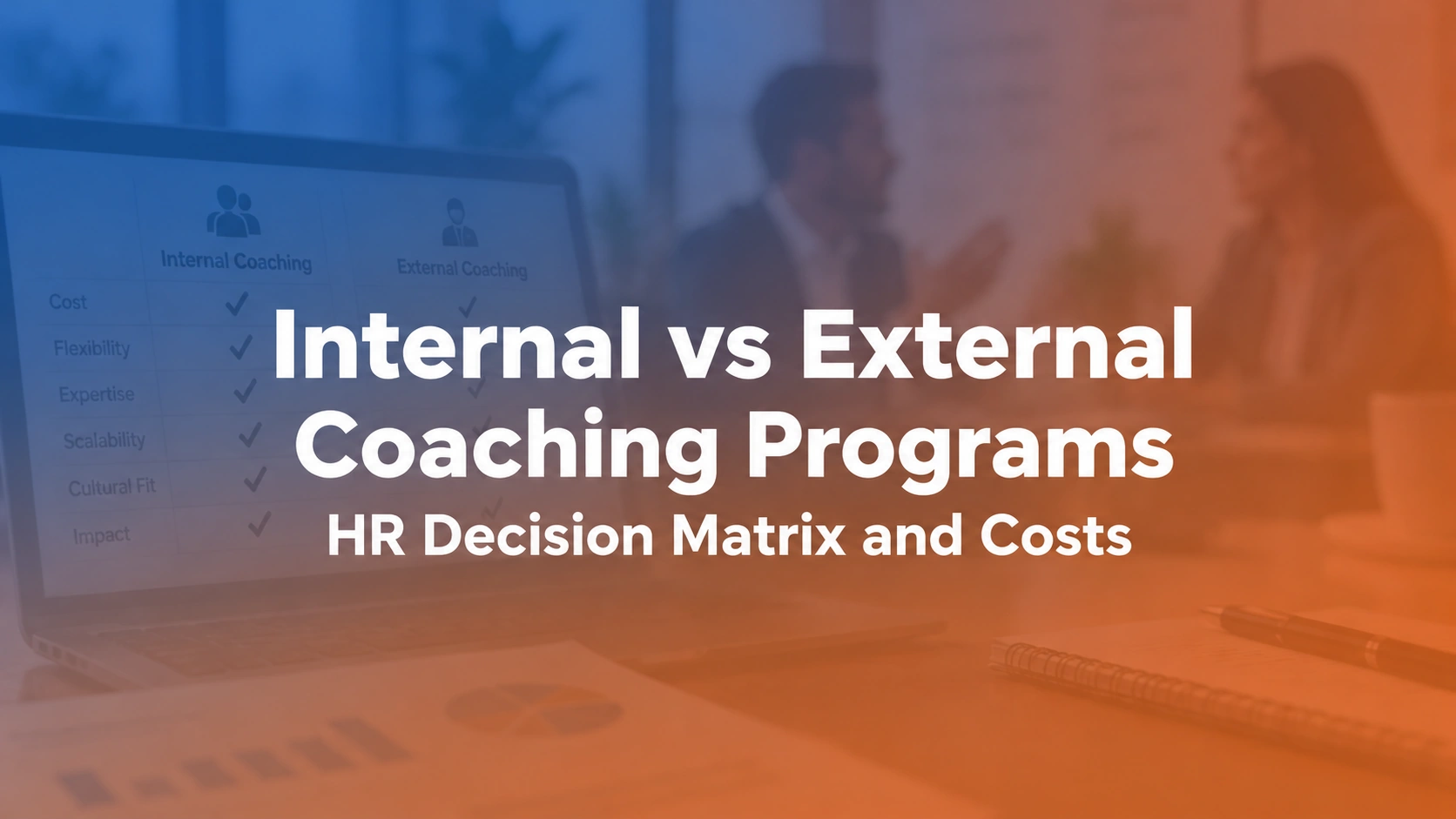

Internal coaching vs external coaching: Internal coaching is delivered by employees of the organization, while external coaching is provided by independent contracted professionals. Internal coaches may know the culture and work context better; external coaches can bring specialized experience and greater distance from internal hierarchies. Neither is automatically more effective or cheaper. HR should compare coaching goals, conflicts of interest, confidentiality, capacity and total cost before selecting a model.
This guide includes a side-by-side comparison, a weighted selection example, a coaching cost calculation and a free Excel decision matrix. All numbers below are fictional illustrations, not published vendor prices or Trainery customer results. If HR needs to administer both coaching models, see employee coaching software after the program's goals and permissions are defined.
Internal vs external coaching: comparison for HR teams
Use the table to identify tradeoffs rather than making a blanket decision. An internal coach may be more available but less independent in a specific reporting relationship. An external coach may provide specialist knowledge yet require additional onboarding and contracting.
| Decision criterion | Internal coaching | External coaching |
|---|---|---|
| Organizational context | Familiar with internal systems | Requires onboarding |
| Perceived independence | Potential conflicts or hierarchy | Often more separate from workplace reporting |
| Cost visibility | Allocated internal time | Contract fees and related costs |
| Specialist expertise | Depends on internal bench | May expand available specialties |
| Capacity | Competes with internal responsibilities | Contracted availability |
| Data access | Existing employee permissions need review | Least-privilege temporary access needed |
How are internal coaching and external coaching different?
Internal coaches are employees who coach as part of their job or in a dedicated role. External coaches are contracted providers outside the employer. The distinction is about the coach's relationship to the organization, not about the quality of their work or the size of the session. Both models need goal-setting, appropriate preparation, clear sponsor boundaries and evaluation.
Example: An internal coach in another department may understand company systems and have no reporting role over the employee. An external coach could bring useful perspective but still have conflicts if they advise another stakeholder. CIPD's coaching guidance emphasizes fit, managerial power dynamics and supervision rather than a universal preference for either source.
When choosing a program structure, compare coaching program management with internal coaching management. The first concerns oversight; the second concerns how coaches are assigned and supported.
When should HR use internal coaches?
Internal coaching is worth considering for recurring manager development, routine role transitions and employees who benefit from organizational context. It can support an ongoing coaching culture without a new external contract for each engagement. However, HR must budget coach training, practice, supervision, workload capacity and a conflict-of-interest review. A line manager's performance-management responsibilities may limit what they can promise as confidential coaching.
Example: If a designated internal coach also votes on the employee's promotion, that dual role could undermine trust. Change the match, explain the role clearly or offer an external option. The ICF Code of Ethics addresses multiple roles and conflicts for ICF professionals, including those working inside organizations.
Define assignment responsibilities before enabling coach and coachee management. Employees needing an outside provider may require a separate external coaching management workflow.
When is an external coach a better fit?
External coaching may suit sensitive leadership transitions, specialist development needs, conflicts involving the management chain or a temporary shortage of qualified internal coaches. A provider outside the hierarchy may be perceived as more independent, but confidentiality and impartiality still need explicit agreements. Check actual credentials, relevant experience, conflicts, references when appropriate and availability—not just a vendor's marketing claims.
Example: An executive handling a confidential restructuring concern may prefer an external professional. HR should confirm how the coach will understand the organizational setting while limiting unnecessary access to company and personnel records.
Use coaching engagement management and session tracking as operational context, not as proof that a coach's private notes should be shared.
Does an external coach offer better confidentiality?
Not automatically. External coaches may be outside the reporting chain, but their contracts, systems and sponsor-reporting rules still matter. Internal coaches may have conflicts when they supervise, assess or otherwise influence the coachee's career. Before either relationship begins, agree who can access notes, what progress information goes to HR, how long records are retained, and how lawful exceptions are handled. The ICF's current ethics code addresses sponsor agreements, privacy and conflicts of interest; these obligations apply to ICF professionals, not automatically to every employee acting as a coach.
Example: The sponsor receives participation status and the agreed high-level development goal, not a transcript of private sessions. If HR needs more detail, review the agreement and purpose before changing information-sharing arrangements. Do not assume payment for coaching gives the sponsor ownership of confidential conversations.
Define sponsor-visible metrics before designing coaching analytics reports. The manager coaching guide offers related program considerations.
Ask Trainery to demonstrate internal-to-external coach handoffs, role-based permissions and sponsor-approved reporting using an anonymized HR scenario.
How much does internal coaching actually cost?
Internal coaching has real costs even without a vendor invoice. Include coach delivery hours, preparation and follow-up, an agreed fully loaded labor rate, training, supervision, scheduling and any allocated tools. A finance-approved labor allocation reflects capacity consumed; it is not necessarily a new cash expense. Keep opportunity cost distinct from cash outlay.
Illustrative internal budget: Twelve one-hour sessions with 30 minutes of preparation or follow-up per session consume 18 hours. At an illustrative loaded labor rate of $90/hour, that is $1,620. Add $600 of supervision and training allocation plus $300 of coordination for a $2,520 planning cost. Verify your own rates and allocation method rather than treating these values as a market benchmark.
The leadership coaching guide helps clarify the type of development needed; the coaching software guide covers operational questions, not published coaching rates.
How do you calculate the full cost of external coaching?
Include contracted sessions, optional assessments, preparation included or excluded in the fee, cancellation or travel charges where applicable, procurement, onboarding and program coordination. Confirm whether each proposal covers the same session count, duration, reporting boundaries and matching arrangements. Example: Twelve sessions at $180 each total $2,160; adding $400 procurement and $200 coordination creates an illustrative $2,760 program cost. Compared with the hypothetical $2,520 internal plan above, the difference is $240—not evidence that internal coaching is more effective or cheaper at every scale.
Always add the coachee's time if your organization uses fully loaded economics, and avoid mixing different cost periods. Vendor quotes, employee salaries and contractual details will change the calculation.
Before spending on coaching, compare the goal with an existing employee development program and the evidence from skills gap analysis. A missing process is not always a coaching need.
Can an organization combine internal and external coaching?
Yes. A blended coaching program can use employees for broadly shared development needs and external specialists when independence, expertise or capacity matters more. Define eligibility, referral ownership, separate agreements and the permitted handover information before moving a person between coaches. A blended program is not a shortcut around confidentiality requirements.
Example: New managers work with trained internal coaches on routine delegation goals, but an employee dealing with a sensitive leadership dispute can ask for an external specialist. HR tracks the engagement status without sharing private conversation notes between coaches without appropriate authorization.
For role-based coaching decisions, skills matrices and competency-based training may clarify common development themes.
How do you score internal vs external coaching in an HR decision matrix?
List the decision criteria first: independence, relevant coaching expertise, available capacity, organizational knowledge, total cost, and any accessibility or location requirements. Give each criterion a weight adding up to 100%, then rate each option against explicitly agreed evidence on the same 1–5 scale. For a weighted score on a 1–5 scale, multiply each rating by its weight and add the results. The result makes assumptions visible; it does not objectively predict employee outcomes.
Illustrative selection: For an executive transition, set independence 30%, expertise 25%, availability 20%, organizational context 15% and cost 10%. Suppose internal coaching scores 2, 3, 4, 5 and 4; the weighted total is 3.30/5. An external option scored 5, 5, 3, 3 and 2 totals 4.00/5. These ratings are examples, not measured provider performance. For a frontline manager cohort, update the weights and evaluate anew.
Use a training needs analysis when deciding between coaching and formal instruction. Keep any learning intelligence reporting separate from private coaching records.
| Criterion | Weight | Internal score (1–5) | External score (1–5) |
|---|---|---|---|
| Independence | 30% | 2 | 5 |
| Expertise | 25% | 3 | 5 |
| Availability | 20% | 4 | 3 |
| Company context | 15% | 5 | 3 |
| Cost | 10% | 4 | 2 |
| Weighted result | 100% | 3.30 / 5 | 4.00 / 5 |
How to use the free internal vs external coaching Excel worksheet
Use the decision matrix workbook above to discuss options with HR, L&D, the intended coachee and the program's finance or procurement owner. Enter only approved program information; do not use a shared scoring sheet to store confidential coaching conversations.
- Define the goal and audience: describe who needs coaching and which outcomes matter, without adding unnecessary personal information.
- List eligible options: internal coach, external coach and blended pathway where appropriate.
- Agree criteria and weights: determine independence, expertise, availability, organizational context, accessibility and cost priority before comparing providers.
- Document evidence: note demonstrated experience, capacity, actual contract terms and any conflict that changes eligibility.
- Compare total cost: include internal time and supervision or external fees and procurement overhead on consistent assumptions.
- Set privacy rules: distinguish program-status reporting from private coaching content and record the permitted sponsor summary.
- Review the pilot: evaluate goal progress, participant trust, delivery capacity and cost before expanding the program.
Use the spreadsheet as a decision aid, not as an automatic determination of employee eligibility or performance. Have the responsible legal, finance and privacy owners validate organization-specific requirements.
What should HR ask a coaching platform vendor to demonstrate?
Ask for a realistic anonymized scenario: one internal coach with a second organizational role, one external coach with limited access, and an employee who changes coaches midway. Can the platform keep each engagement's permitted reporting separate from private conversation notes? Can it document qualifications, coach availability, sponsor-approved milestones and access revocation? Test the precise requirements in a demo rather than assuming every feature is active. For related examples, see internal coaching management, external coaching management and coaching analytics.
HR selection scenario: evaluate independence before price
Consider a leadership program serving frontline managers and a smaller set of executives. Internal coaches already understand the organization's operating model and may provide practical support to frontline managers. However, some executive coaching topics involve confidential conflicts or decisions where internal independence could be questioned. HR could choose a mixed arrangement, provided the assignment criteria and reporting boundaries are clear. For the internal option, calculate the training, supervision and work hours diverted from other responsibilities. For the external option, include fees, contracting, onboarding and administrative time. Use a weighted decision matrix only after clarifying what matters in each scenario: confidentiality, experience, schedule access, organizational knowledge or specialist expertise. Do not use the same weights for every participant. After launch, look for goal progress, coach fit, participant trust and program sustainability. The lower nominal invoice is not necessarily the lower total cost, and the more expensive coach is not automatically the stronger choice.
Conclusion: select the coach, then validate the outcome
Internal and external coaches bring different strengths and tradeoffs. Choose the model that gives employees the right expertise and a trustworthy relationship under clear cost and confidentiality rules. Use the decision matrix to document why an option fits, pilot it with a small group and evaluate agreed behavior changes before scaling. To coordinate multiple engagements, explore TraineryCoaching and ask for a demonstration of an internal-to-external coach handoff with restricted sponsor reporting.
Bring your decision matrix and ask how the proposed setup would support coach matching, scheduling, privacy boundaries, program milestones and reporting.
Book a Trainery DemoDownload your workbook
Enter your name and work email to unlock the Excel file.