
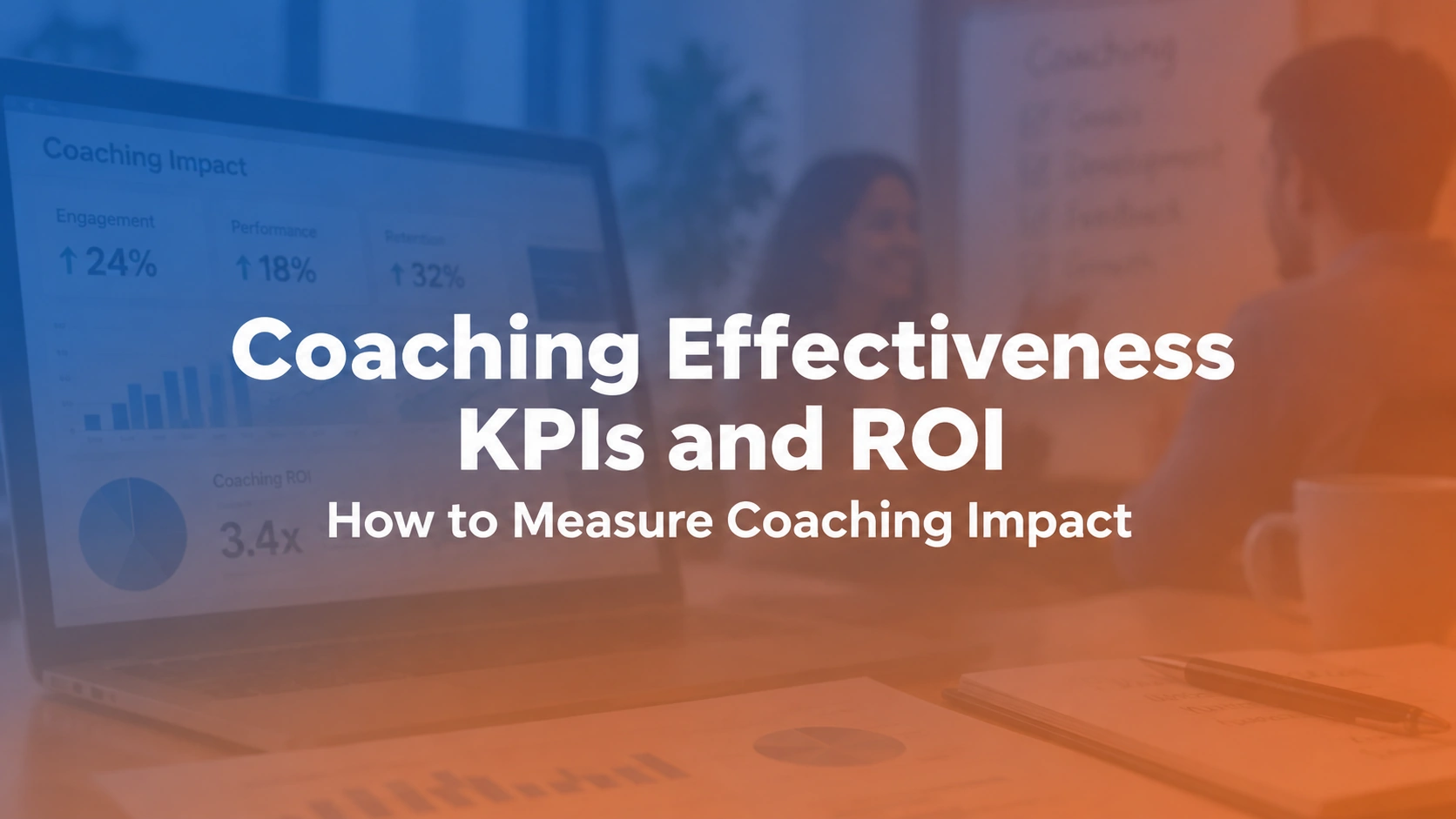

Employee coaching effectiveness is measured by whether a person applies agreed development behaviors at work and makes progress toward a meaningful goal. Start with a baseline, review observable changes, and collect feedback within agreed privacy boundaries. Attendance and satisfaction show participation, not impact. Calculate coaching ROI only when monetary benefits and the portion reasonably attributable to coaching can be supported.
This guide gives HR and L&D teams a practical measurement framework, sample KPIs, a worked ROI calculation and a free Excel worksheet. The scenarios are fictional, not Trainery customer performance claims. If your team runs multiple engagements, employee coaching software may help coordinate approved program records; it cannot replace evidence of behavior change.
How do you measure coaching effectiveness? Six evidence layers
Choose evidence based on the purpose of the coaching engagement. Keep activity, behavior change, goal progress and financial outcomes separate in reports. The table below gives examples and their limitations, not a standardized scoring system.
| Measurement layer | Suggested evidence | Important limitation |
|---|---|---|
| Participation | Scheduled and completed sessions | Activity is not effectiveness |
| Behavior change | Agreed observable work examples | Requires context and baseline |
| Goal progress | Milestones met or revised | Goals may change |
| Stakeholder feedback | Consented, structured observations | Subject to bias |
| Business outcome | Relevant quality or delivery metric | Many factors affect results |
| ROI estimate | Validated benefits minus program cost | Attribution must be disclosed |
What should HR measure before coaching starts?
Agree on why coaching is being offered, the target behavior, the source of evidence and a realistic observation date. A baseline may come from a work artifact, a structured observation, the coachee's own examples, or authorized stakeholder feedback. Ask whether the person has a fair opportunity to practice the behavior. Record who may view each measure before collecting it.
Example: A newly promoted manager wants to improve project escalations. Before coaching, the manager and coachee agree to review two anonymized project handoffs: whether they named the decision owner and escalated risks on time. After several practice opportunities, review comparable cases. These are illustrative checkpoints, not a universal KPI target.
Program-level oversight differs from individual coaching. Compare employee coaching software and coaching program management when deciding which baseline fields to store.
What is the difference between coaching activity and coaching outcomes?
Activity metrics describe service delivery: sessions scheduled, attendance and actions assigned. Outcome metrics describe development: behaviors practiced, milestones reached and changes supported by credible observations. A program can perform well operationally without delivering its intended developmental outcome. The Kirkpatrick Model likewise distinguishes participant reactions, learning, workplace behavior and organizational results; it is a helpful evaluation lens but should not be presented as a coaching-specific causal test.
Example: An employee attends six coaching sessions and completes every reflection task but still avoids difficult stakeholder conversations. Record high participation and incomplete behavioral progress separately, then revisit the coaching approach.
A manager-led program may have different reporting arrangements from a third-party engagement. Compare internal coaching management with external coaching management when defining the evidence that can be shared.
Which employee coaching KPIs should L&D track?
Start with three to five relevant measures rather than building a dashboard of everything available. Common choices include the percentage of agreed actions completed, observable goal-progress milestones, evidence of applying a target behavior, coaching-session completion and authorized stakeholder feedback. For a broader program, assess coach capacity and administrative spend separately. Coachee confidence is supporting feedback—not a substitute for observed improvement.
Example: For delegation coaching, review how responsibilities and decision rights were documented in actual work. Count practice actions where useful, but don't treat the number of notes entered into the system as evidence of improved delegation.
Review coach and coachee management and engagement management for coordinating agreed milestones without recording unnecessary sensitive detail.
| KPI | How to measure | Interpretation limit |
|---|---|---|
| Action completion | Agreed actions completed ÷ actions due | Shows practice, not effectiveness |
| Observed behavior change | Comparable examples before and after coaching | Other workplace factors may contribute |
| Goal progress | Milestones achieved against an agreed goal | Goals can be revised appropriately |
| Sponsor feedback | Authorized, structured observations | Potential bias; confidentiality limits |
| Financial benefit | Value validated and attributed to coaching | Estimate must disclose assumptions |
How can HR verify behavior change after coaching?
Define the desired behavior before the program, capture a baseline, allow time and support for practice, and compare later observations. Look for consistent examples, not a single lucky outcome. Ask what else changed—team staffing, responsibilities, technology or manager support—before attributing improvement to the coaching engagement.
Example: After a client escalation, the coachee documents a clearer decision path. Record what was different, who observed it and whether new escalation guidelines were introduced at the same time. A specific work example is more informative than an unexplained increase on a subjective rating scale.
See coaching session tracking and coaching analytics for related operational data. Neither type of record independently proves a causal effect.
Ask to see an employee goal change, coach reassignment, sponsor view and privacy control in Trainery's program workflow.
What does research say about coaching effectiveness?
A 2025 research paper on coaching effectiveness describes evidence of outcomes such as goal attainment, well-being and behavioral change, while noting gaps in the understanding of mechanisms and consistent measurement across organizations. It supports using several evidence types and being cautious about sweeping claims. The Kirkpatrick Model, developed for training and other initiatives, offers a useful distinction between participant reaction, learning, workplace behavior and organizational results. Neither reference proves that any individual coaching engagement caused a measured business result.
How do you calculate ROI for employee coaching?
Coaching ROI (%) = [(monetary benefits reasonably attributed to coaching − total program cost) ÷ total program cost] × 100. Use a consistent period and cost scope. Only calculate financial ROI when the business benefit can be valued credibly and the estimated coaching contribution can be explained. The presence of a formula does not prove causation. The Phillips coaching ROI case study describes a structured evaluation approach rather than an automatic return for every program.
Illustrative calculation: A program costs $12,000. The organization estimates $30,000 of potentially relevant value, but only $18,000 can reasonably be linked to coaching under its documented assumptions. Estimated net benefit is $6,000 and estimated ROI is 50%: ($18,000 − $12,000) ÷ $12,000 × 100. The unverified $12,000 difference must not silently count as a coaching benefit. If the $18,000 attribution is not credible, report the financial case as unverified rather than publishing 50% as a proven outcome.
For development context, see the manager coaching program guide and leadership coaching guide. Evaluate behavior and business impact separately.
What costs belong in an employee coaching ROI calculation?
Include external coach invoices or agreed internal labor allocations, program administration, assessments, applicable software costs and participant time if finance requires a fully loaded model. Distinguish one-time design or setup from ongoing session delivery. Avoid counting a platform license or payroll allocation twice. Use the same currency, period and cost boundary for both sides of the equation.
Example: A ten-person pilot may have high one-time setup costs. Present both the pilot's actual total cost and a separately labeled estimate for repeat delivery rather than comparing them as identical programs. Internal time allocations do not automatically create realizable cash savings.
The employee coaching software guide and employee development programs guide describe adjacent decisions; neither defines the finance assumptions for a specific ROI case.
How should HR report coaching KPIs without exposing private sessions?
Agree on reporting boundaries among coach, coachee and sponsor before gathering individual information. Prefer approved operational status, high-level goal progress and aggregation where safe. Avoid placing private conversations, personal disclosures or coach notes in an unrestricted dashboard. The ICF Code of Ethics sets expectations for confidentiality and information-sharing arrangements in professional coaching; the organization also needs its own applicable privacy and retention policies.
Example: A five-person pilot may be identifiable even when names are removed. Do not promise anonymity merely because a report is aggregated. Share only what the participants have been told will be collected and what the relevant agreements and laws permit.
Where a coaching goal concerns work skills, a skills gap analysis or skills matrix may inform the baseline, subject to appropriate access permissions.
What should the employee coaching evaluation worksheet include?
For each engagement, record an authorized goal, starting baseline, evidence source, observable action, follow-up date and progress status. For program-level ROI, use separate fields for period, cost categories, gross potential benefit, evidence supporting attribution, estimated attributable benefit and verification status. Keep the outcome discussion useful even if no financial result can be calculated.
Example: A manager's estimate that a coaching participant “saved 100 hours” belongs in a provisional assumptions field until the time saving, its financial value and contribution of coaching are substantiated. The worksheet should never turn an empty attribution field into an automatic 100% assumption.
Use the competency-based training guide and training needs analysis to identify when a learning or process intervention may fit better than coaching alone.
How to use the free coaching effectiveness and ROI Excel worksheet
Use the workbook above to organize a small set of agreed development indicators and record the assumptions behind any financial estimate. Do not enter confidential session transcripts in a broadly shared file.
- Set the evaluation purpose: choose a development goal, define its observable behavior and name the review owner.
- Capture a baseline: record a dated example or approved metric from before the coaching engagement.
- Record activity separately: track completed sessions and agreed actions without treating them as outcomes.
- Review change: document after-coaching examples, feedback context and other factors that may have influenced the result.
- Enter program costs: use a consistent period and define whether the cost view includes participant time or one-time setup.
- Validate financial benefits: describe how the benefit was valued and why some portion may be attributable to coaching. If attribution is missing, leave ROI unverified rather than guessing.
- Agree on sharing: review the draft summary against the confidentiality and sponsor-reporting agreement before circulation.
This worksheet supports evaluation decisions; it is not a causal model. For larger programs, use a separately governed reporting process that maintains auditability and access controls.
What should an HR team ask a coaching platform vendor to demonstrate?
Choose an anonymized coaching engagement and ask the vendor to show the planned goal, agreed milestone status, permission-scoped reporting and one revised action. Verify whether the platform distinguishes engagement activity from actual behavioral evidence, and whether reports can exclude private notes. Ask what a finance analyst would export to validate program costs and how exceptions or missing data appear. See coaching analytics and coaching engagement management for relevant product context. Demonstrate the specific capabilities needed rather than inferring them from product-page terminology.
ROI worksheet example: an attractive number that is not yet evidence
An organization spends $12,000 on a coaching pilot. Several participants report stronger decision-making and one department's delivery performance improves. It would be tempting to assign the entire improvement to coaching and produce a large ROI percentage. Instead, document the baseline, the behavior each participant practiced, how the operational measure changed and which other events occurred, such as staffing or software updates. Ask finance whether any improvement can reasonably be valued in money and which portion can be attributed to coaching. If that attribution is not credible, leave the monetary-benefit field unverified and report the observed nonfinancial change. In the workbook, an ROI formula should use only approved benefits and costs; a blank attribution field must not silently become a 100% assumption. This is more credible than presenting precision the evaluation cannot support. The reporting can still show participation, goal progress, coachee feedback and plans for the next review.
Conclusion: measure development before claiming return
A credible coaching effectiveness report makes three things clear: what behavior the person worked on, what evidence suggests it changed, and what cannot yet be attributed to coaching. Start with a short list of useful KPIs and a privacy-safe baseline. Use the free Excel worksheet to record progress and cost assumptions, then calculate ROI only where validated monetary benefits justify it. If coordinating many coaching engagements is the larger challenge, evaluate TraineryCoaching against a real goal-review and reporting scenario.
Review Trainery's coaching program and engagement workflows with your HR team. Bring an anonymized development plan and ask how the system handles confidentiality, scheduling, milestones and reporting.
Book a Trainery DemoDownload your workbook
Enter your name and work email to unlock the Excel file.