

.svg)
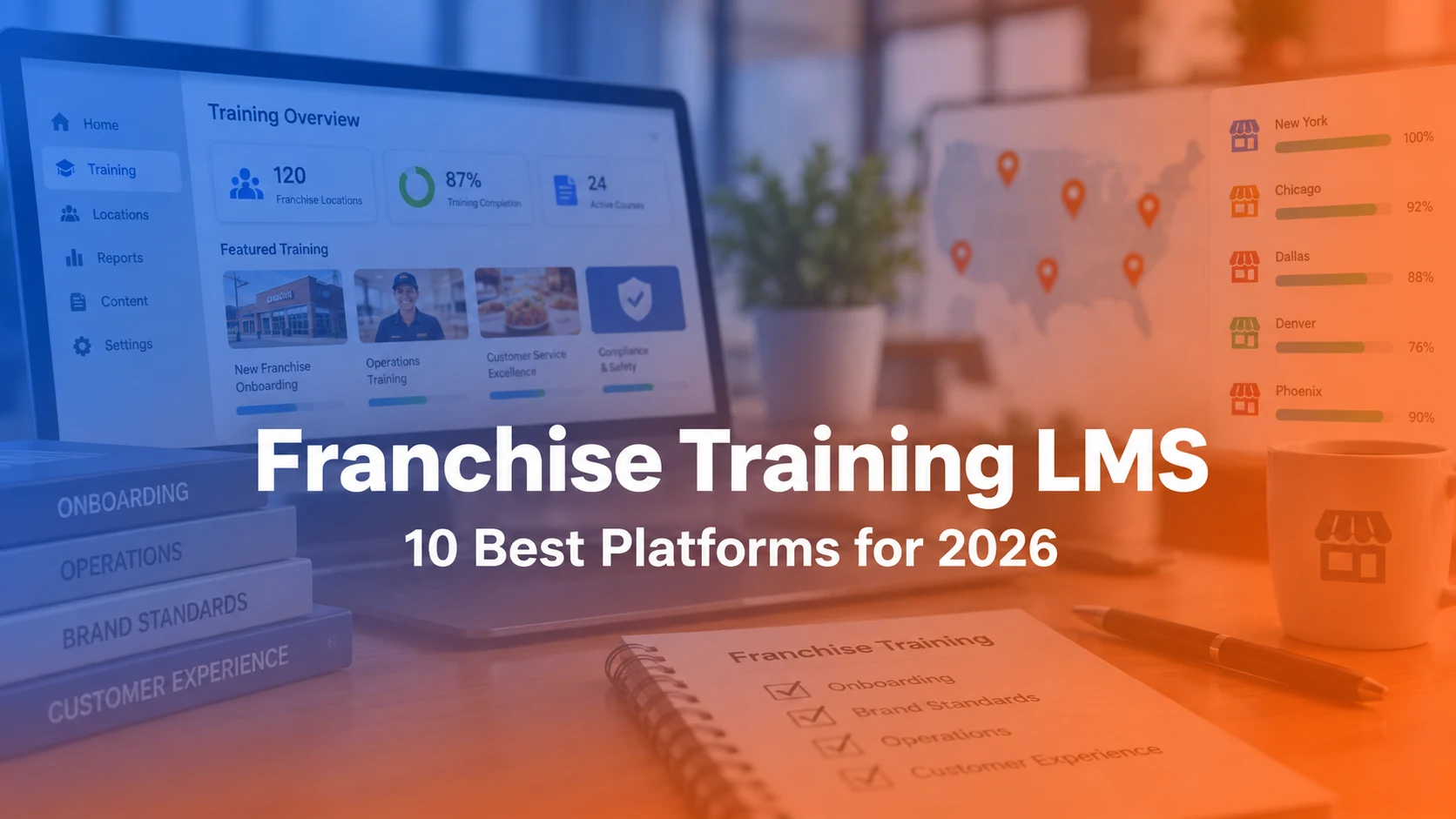

A franchise training LMS has to solve a structural problem that ordinary employee-training platforms often miss: corporate needs consistent brand, operations, product, and compliance standards across the network, while franchisees, regions, and locations still need enough scoped control to onboard and manage their own teams.
That makes franchise training software more than a course library. The platform may need to represent the real network hierarchy, protect learner privacy between franchisees, govern HQ-owned content, allow approved local variation, automate role-based onboarding, support frontline mobile learning, track certifications, and roll reporting up from location to corporate.
This guide compares ten platforms that can be evaluated for franchise and multi-location training in 2026. Trainery.ai publishes the comparison and Trainery appears first, so that commercial relationship is disclosed. Public vendor documentation was reviewed on September 26, 2026. Validate the exact package, hierarchy, permissions, security, live-training model, implementation, and contract terms in a configured demonstration.
How we evaluated franchise training LMS platforms
We evaluated each platform against the workflows that determine whether a franchisor can maintain consistency without turning every local training change into a corporate administration task.
For broader procurement, combine these criteria with the LMS vendor evaluation and RFP guide, LMS security checklist, and LMS migration checklist.
10 franchise LMS platforms at a glance
| Platform | Best-fit scenario | Capability to test | Demo question |
|---|---|---|---|
| Trainery | Franchise learning connected to broader training operations | LMS, ILT/VILT, certifications, learning paths, compliance, and network reporting | Can one location change update assignments, live training, credentials, and reporting without manual reconciliation? |
| LearningZen | Purpose-built franchise training | Location-based organization, mobile learning, brand consistency, certifications, and branch reporting | How closely can the LMS mirror our franchisor, region, franchisee, and unit structure? |
| Thrive | Multi-brand franchise and extended-enterprise learning | Multi-tenancy, branded portals, role/location access, campaigns, compliance, and centralized analytics | How are tenants separated while HQ retains network-wide reporting and governance? |
| Docebo | Large complex or global franchise networks | Extended enterprise, multiple domains, audience-specific experiences, certifications, and integrations | Can two franchise groups have separate branding and admin rights while sharing selected master content? |
| LearnUpon | Franchise training as one of several external learning audiences | Portals, sub-portals, centralized administration, branding, user separation, and audit trails | How are portals governed and how will live-training requirements be handled after the 2026 ILT change? |
| TalentLMS | SMB and mid-market franchise networks | Branches, separate branded training environments, role-based learning, certifications, and delegated administration | Does the branch model match our actual franchise hierarchy and privacy boundaries? |
| WestNet LMS | Multi-location franchise compliance and onboarding | Region/location hierarchy, local admin roles, mobile delivery, certification, and corporate dashboards | Can local admins add approved training without changing corporate-owned content? |
| Teachfloor | Master-franchise onboarding and structured network rollouts | Master curriculum, multi-branch administration, local variants, certification, live training, and reporting | Can HQ push a brand-standard change network-wide while preserving approved local variations? |
| SimpliTrain | Franchise networks needing isolated branded location portals | HQ-to-region-to-location hierarchy, tenant isolation, central content, branded portals, and consolidated compliance reporting | Exactly which records are isolated by tenant and which metrics roll up to HQ? |
| Moodle Workplace | Organizations prioritizing configurability and multi-tenancy | Tenants, programs, certifications, dynamic rules, mobile learning, reporting, and integrations | Which requirements are native, configured, partner-delivered, plugin-dependent, or custom? |
1. Trainery: for connected franchise learning operations
TraineryLMS is relevant when franchise learning extends beyond self-paced courses into connected ILT/VILT operations, certification tracking, role-based learning paths, compliance workflows, and network reporting.
Best fit: networks that need digital learning, live training, recurring requirements, and centralized operational visibility to stay connected across locations.
What to test: create two franchise locations with different local admins, assign a shared corporate program, add one local requirement, transfer a learner between units, and inspect assignments, history, permissions, attendance, credential status, and reporting.
2. LearningZen: purpose-built franchise training
LearningZen explicitly positions its platform as a franchise training LMS. Its current franchise materials emphasize centralized onboarding, role- and location-based organization, mobile access, brand consistency, branch-specific reporting, certification workflows, and multi-brand support. See LearningZen Franchise Training LMS.
Best fit: franchisors that want a purpose-built franchise training model rather than adapting a general LMS from scratch.
What to test: reproduce the exact franchisor, region, area developer, franchisee, and location structure. Verify what each admin can see, which content they can change, how certifications are renewed, and how reporting rolls up.
3. Thrive: for multi-brand and extended-enterprise franchise learning
Thrive's 2026 franchise and extended-enterprise materials explicitly emphasize multi-tenancy, branded portals, role- and location-based access, compliance and certification tracking, campaigns, mobile learning, and centralized analytics across franchise groups, regions, and partner networks. See Thrive Franchise Training.
Best fit: organizations that operate multiple franchise groups or also train dealers, partners, customers, or other external audiences.
What to test: create two tenants with different branding and local admins, reuse one approved master course, vary one permitted local element, and prove that reporting rolls up without exposing one tenant's learner data to another.
4. Docebo: for complex global franchise networks
Docebo's Extended Enterprise product explicitly includes franchises among the external audiences it is designed to support. It can create multiple learning experiences from one platform with distinct administrative rights, branding, authentication, catalogs, certifications, and centralized reporting. See Docebo Extended Enterprise.
Best fit: larger or global networks with several brands, regions, external audiences, enterprise integrations, or complex governance requirements.
What to test: build two franchise groups with separate branding and administrators, share selected HQ content, apply one group-specific requirement, and verify reporting, authentication, and content governance across both.
5. LearnUpon: for franchise training across separate portals
LearnUpon's portal architecture allows organizations to configure separate branded learning environments under centralized administration, with sub-portals, audience-specific settings, users, content, and portal-level audit trails. One important 2026 caveat: LearnUpon removed native ILT session management from portals on April 14, 2026, so franchise networks with live-training requirements should validate the current delivery or integration model rather than relying on older comparisons. See LearnUpon Portals and its March 2026 product update.
Best fit: organizations where franchisees are one of several distinct learning audiences and separate branded portals are more important than a deep native ILT workflow.
What to test: reuse one course across multiple portals, change branding and permissions, move or share a learner where supported, verify audit trails, and demonstrate how any live-training requirement works in the proposed 2026 setup.
Bring your actual network hierarchy to the demo.
Test one new location, central brand training, an approved local variation, a role transfer, an expiring certification, and network reporting before you shortlist a platform.
6. TalentLMS: for simpler branch-based franchise training
TalentLMS Branches create separate training environments with their own branding, catalog, users, administrators, and reporting while remaining centrally managed. That model can fit franchise networks with relatively straightforward hierarchy and separation requirements. See TalentLMS Branches.
Best fit: emerging and mid-market franchise systems that want faster deployment and clear separation by branch or audience without a highly customized enterprise architecture.
What to test: map the actual franchisor, master-franchise, region, and location structure to Branches. Verify admin scope, learner moves, content reuse, certifications, SSO, and reporting before assuming the hierarchy is deep enough.
7. WestNet LMS: for multi-location hierarchy and compliance
WestNet's franchise LMS materials emphasize corporate-controlled content, region and franchisee hierarchies, custom local admin roles, automatic assignment by role or location, certification tracking, mobile-first delivery, and real-time network compliance dashboards. See WestNet LMS for Franchises.
Best fit: multi-location networks where corporate governance and local administration must coexist without weakening brand or compliance controls.
What to test: let a local administrator upload an approved location-specific item, then prove that corporate-owned content cannot be altered, local learner access is scoped correctly, and HQ reporting remains consistent.
8. Teachfloor: for master-franchise onboarding and network rollouts
Teachfloor's current franchise product is built around a master-franchise model with HQ-owned curriculum, multi-branch administration, brand-locked content, controlled local variants, franchisee certifications, live training, and network reporting. See Teachfloor LMS for Franchise.
Best fit: franchise systems that need structured pre-opening onboarding, cohort or live learning, certifications, and synchronized network-wide rollouts.
What to test: run a new-franchise opening journey for owner and manager roles, then push a product or brand-standard update to all existing locations while preserving one approved local variation.
9. SimpliTrain: for isolated multi-tenant franchise environments
SimpliTrain's franchise training product describes an HQ-to-region-to-location hierarchy, centrally controlled master content, independently branded location portals, consolidated compliance reporting, and tenant-level learner-data isolation. See SimpliTrain Franchise Training Management Software and its multi-tenant architecture.
Best fit: networks where location or tenant isolation, branded portals, and central oversight are explicit design requirements.
What to test: verify exactly which data is isolated per tenant, which metrics HQ can aggregate, what local administrators can change, and how an HQ course update propagates to existing locations.
10. Moodle Workplace: for configurable franchise multi-tenancy
Moodle Workplace is the enterprise product to evaluate—not core Moodle LMS alone—when franchise multi-tenancy is the requirement. Its current feature set includes separate tenants for divisions or franchises, programs, recurring certifications, Dynamic Rules, custom reports, mobile learning, and the ability to reuse content and selected objects across tenants. See Moodle Workplace features.
Best fit: organizations that want significant configurability and are prepared to make explicit implementation, partner, hosting, integration, and governance decisions.
What to test: label each requirement as native, configured, partner-delivered, integration-dependent, plugin-dependent, custom, or unavailable. Include tenant administration, shared content, recurring certification, mobile access, reporting, and upgrade ownership.
What features matter most in franchise training software?
The exact weighting depends on the franchise agreement and operating model, but these are the capabilities that determine whether the system scales beyond a simple course catalog.
If your franchisees are one of several non-employee populations, compare the architecture with Trainery's extended enterprise training capabilities and the partner training software comparison. For frontline-heavy networks, also test onboarding against the employee onboarding training program requirements.
Use one franchise LMS demo scenario for every vendor
A polished learner demo does not prove that the platform can govern a real franchise network. Give every finalist the same network scenario and make them operate it live.
If your program includes significant classroom or virtual instructor-led training, extend this scenario using the training management systems comparison. If historical records must migrate from another platform, use the LMS migration checklist during the same proof-of-capability exercise.
Final selection guidance
A franchise LMS should reduce the tension between consistency and local operation. Purpose-built franchise platforms such as LearningZen, WestNet, Teachfloor, and SimpliTrain deserve consideration when network hierarchy itself is the central problem. Thrive and Docebo fit broader extended-enterprise models. LearnUpon and TalentLMS use portal or branch structures that may suit simpler separation patterns. Moodle Workplace offers configurable multi-tenancy for organizations willing to own more implementation decisions.
Trainery is most relevant when the franchise program needs digital learning to connect with ILT/VILT, recurring certifications, compliance, role-based onboarding, and corporate reporting. Because Trainery.ai publishes this comparison, validate Trainery with the same scripted hierarchy, privacy, content-governance, evidence, security, and commercial checks applied to every other finalist.
Train Every Location Without Losing Network Visibility
See how Trainery can connect franchise onboarding, role-based learning, ILT/VILT, certifications, compliance, local administration, and corporate reporting in one governed training environment.
Book a Demo

.svg)

.svg)
.svg)

