

.svg)
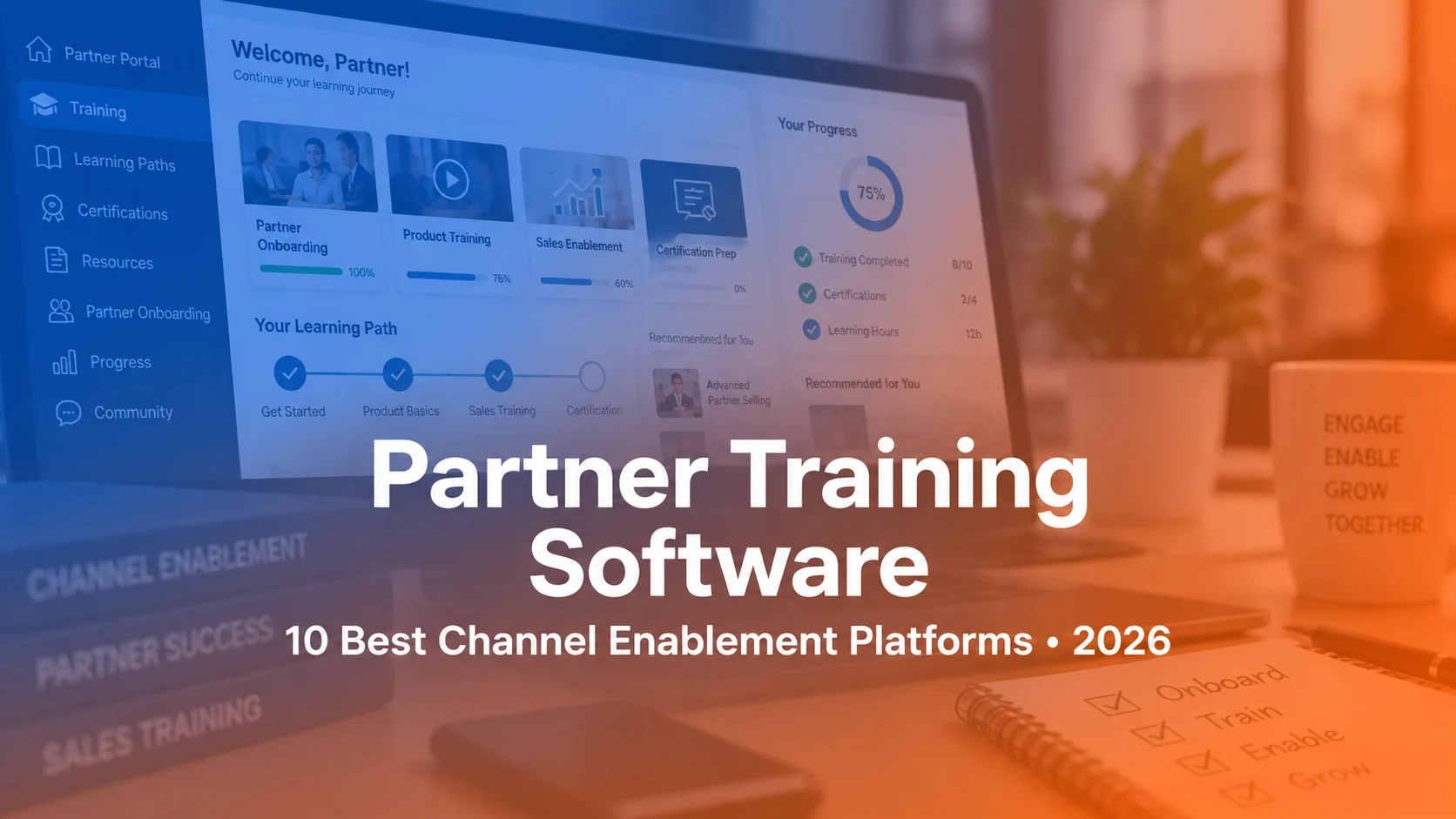

Partner training software gives channel organizations a controlled way to onboard, educate, certify, and continuously enable resellers, distributors, referral partners, franchisees, implementation partners, and other external audiences. In 2026, the buying decision is broader than course delivery: teams need partner segmentation, branded experiences, certification and renewal, CRM or PRM connectivity, delegated administration, analytics, and reliable learning records across organizations they do not directly employ.
This guide compares ten platforms for enterprise and mid-market channel enablement. Trainery.ai publishes the article and TraineryLMS appears first, so that commercial relationship is disclosed. Public product documentation was reviewed on September 26, 2026. This is a use-case shortlist rather than independent hands-on testing; validate package scope, integrations, security, implementation, and contractual commitments in a configured demonstration.
If you are comparing platforms, this guide focuses on software selection. If you are designing the program itself—partner tiers, commercial gates, certification architecture, and channel-operating requirements—use the separate Partner Training Program: LMS Requirements for Channel Enablement guide.
How we evaluated partner training software
We evaluated each platform against the workflows that determine whether a partner academy remains manageable after launch, rather than counting features in isolation.
For broader procurement, pair these criteria with the LMS vendor evaluation and RFP guide and LMS security checklist.
10 partner training platforms at a glance
1. TraineryLMS
TraineryLMS supports internal and external learning and can connect partner onboarding with role-based learning paths, ILT/VILT operations, assessments, credential tracking, compliance workflows, and partner-facing training within a broader learning ecosystem.
Best fit: organizations that want partner onboarding and certification connected to a wider training operating model rather than managed as a standalone academy.
What to test: create a distributor onboarding path with a prerequisite, product course, live session, assessment, and expiring credential. Move the distributor from one partner tier to another and inspect assignments, retained history, notifications, credential status, administrator workload, and reporting.
2. Skilljar by Gainsight
Skilljar is now part of Gainsight and is positioned as an external LMS for customer and partner education. Its current product materials emphasize branded academies, on-demand and live training, learning paths, certifications, SSO, and connections to revenue and customer-success data. See Skilljar by Gainsight.
Best fit: B2B organizations where customer and partner education is closely connected to adoption, retention, certification, and customer-success operations.
What to test: synchronize partner company, learner role, certification, and completion data with the CRM or customer-success platform. Confirm the system of record when account data and learning data disagree.
3. Thought Industries
Thought Industries is purpose-built for external learning across customers, partners, members, and professional audiences. Its partner-enablement materials emphasize customized training and certification, learning paths, segmented experiences, blended learning, and monetization. See Thought Industries Partner Enablement.
Best fit: organizations where the academy itself is a strategic external experience and different partner organizations, personas, brands, or regions need controlled variation.
What to test: configure two partner brands or regions that reuse core content but have different requirements, branding, administrators, certification rules, and reports.
4. LearnUpon
LearnUpon has long supported employee, customer, and partner audiences through portals, and its July 2026 Agentic Learning Platform announcement adds a newer automation direction around learning administration, journeys, reporting, and learner profiles. See LearnUpon's 2026 Agentic Learning Platform announcement.
Best fit: organizations that want centralized multi-audience administration and are evaluating how newer agentic workflows can reduce repetitive work.
What to test: reuse one product curriculum across employee and partner audiences while changing enrollment rules, communications, certification requirements, branding, and reporting. Confirm which agentic capabilities are generally available in the proposed package.
5. Docebo
Docebo's current Extended Enterprise and partner-training materials explicitly cover employee, customer, and partner learning, audience-specific experiences, certifications, separate authentication options, localization, and active-user pricing. See Docebo Partner Training.
Best fit: large or global programs that need multi-audience learning, partner certification, localization, and enterprise-scale administration.
What to test: separate mandatory certification from recommended content, apply different authentication and catalogs to internal and external audiences, and validate how certification expiry, re-training, reporting, and partner-company hierarchy behave.
6. Absorb LMS
Absorb supports targeted training for customers, partners, and internal groups, including distinct branded learning experiences in one LMS. Its 2026 documentation also covers SCORM, AICC, Tin Can/xAPI content and structured curricula and instructor-led courses. See Absorb customer education and external-audience training.
Best fit: organizations that want one corporate LMS to cover employee learning and external audiences without adopting a PRM-centered operating model.
What to test: model a partner company with multiple roles and delegated administrators. Verify branding, enrollment automation, curricula, ILT, content standards, external reporting, and the manual effort required to maintain complex segmentation.
7. WorkRamp
WorkRamp's Customer Learning Cloud is built for customer and partner education through external Academies. Its 2026 documentation includes segments, paths, certifications, events, CRM integrations, workflows, and custom Hub roles for more granular delegated administration. It also documents SSO patterns with PRMs such as Allbound and Impartner. See WorkRamp Customer Learning Cloud.
Best fit: revenue and customer-education organizations that want branded external academies tied closely to CRM, partner, or customer-success workflows.
What to test: use a partner-tier or role attribute to trigger a segment, enrollment, certification, and downstream CRM/PRM update. Confirm what is automatic versus dependent on integration logic.
8. TalentLMS
TalentLMS supports customer and partner training through Branches—separate training environments with their own branding, catalog, URL, users, administrators, and reporting. Branch availability depends on subscription plan. See TalentLMS Partner Training and its Branches overview.
Best fit: small and mid-market partner programs, or enterprise business units, that value fast deployment and straightforward separation between audiences.
What to test: create separate environments for two partner groups, delegate administration, change a learner's branch, and verify course access, historical progress, notifications, reporting, SSO, and any plan-level limitations.
9. Impartner
Impartner approaches partner training from the PRM side. Its current positioning covers partner onboarding, training, co-marketing, performance management, and automation across the partner journey; a 2026 Smartsheet case study specifically highlights certification automation and partner-operations workflows. See Impartner's 2026 Smartsheet case study.
Best fit: enterprises where partner identity, onboarding, enablement, deals, marketing, and channel operations should remain inside the PRM ecosystem.
What to test: build the actual certification model your program requires—including paths, assessment, expiry, renewal, standards-based content, reporting, and historical records—and identify whether any learning requirement needs a separate LMS.
10. Channeltivity
Channeltivity's current Training & Certification module is more substantial than a simple portal checklist. Its integrated LMS supports courses, lessons, quizzes, certifications, expiry, partner- and representative-level reporting, and standards including SCORM, AICC, cmi5, and xAPI. See Channeltivity Training & Certification.
Best fit: channel organizations that want partner training directly inside a PRM alongside partner profiles, enablement, business planning, and other channel workflows.
What to test: reproduce your hardest certification and recertification workflow inside the built-in module. If it satisfies the required learning depth, a separate LMS may add unnecessary integration and identity overhead.
Partner LMS vs. PRM training: which operating model fits?
The old assumption that a PRM training module is always shallow is no longer safe. Some PRMs now provide real course, certification, content-standard, expiry, and reporting capabilities, while dedicated external LMS platforms are adding deeper CRM and PRM connectivity.
If the program spans several external audiences beyond channel partners, compare the architecture with Trainery's extended enterprise LMS guide. If the issue is primarily program design rather than software selection, use the partner training program guide.
Features to require for channel partner training
The exact priority depends on your partner model, but the platform should be able to prove the workflows that govern access, certification, data ownership, and partner-level reporting.
For more detail on credential workflows, see TraineryCredentials. For integration architecture, review Trainery integrations. For broader LMS capability boundaries, use the LMS features evaluation guide.
Use one partner-tier-change scenario for every vendor
Create one partner company with three learners: sales, technical, and administrator. Assign onboarding plus role-specific certification. Let one learner complete part of the program, then promote the company to a higher partner tier.
Require each vendor to show which new assignments appear, what prior history is retained, how due dates and certification expiry change, which communications fire, what delegated administrators see, and what updates flow to the CRM or PRM. If historical learning needs to move from an existing platform, add the LMS migration checklist to the same proof-of-capability exercise.
Measure partner enablement beyond course completion
Completion is necessary, but it does not establish business impact by itself. Define measures such as certification coverage by partner tier, time to first certification, renewal risk, active participation, product readiness, and channel outcomes that can be joined reliably to learning records.
Keep causal claims conservative unless the data model supports them. A CRM integration may show that trained partners have higher deal activity, but that correlation is not automatically proof that training caused the difference. Build the reporting model before promising an ROI story. Trainery's reporting and analytics capabilities can be evaluated against those required dimensions.
Implementation and governance checklist
Document identity provisioning, partner-company data ownership, taxonomy, certification rules, content owners, localization, delegated administration, support, integration responsibilities, reporting definitions, data retention, security, accessibility, renewal terms, and exit requirements before contract signature.
If customer and partner education share infrastructure, compare the requirements with the customer training software guide. If the program also includes regulatory or mandatory requirements, evaluate the credential model alongside compliance training.
Final selection guidance
TraineryLMS fits evaluations where partner learning must connect structured curricula, live training, credentials, compliance, and broader training operations. Skilljar and Thought Industries are purpose-built external-learning options. LearnUpon, Docebo, Absorb, WorkRamp, and TalentLMS provide different models for serving internal and external audiences. Impartner and Channeltivity are particularly relevant when PRM workflows—not the LMS alone—are the center of the partner operating model.
Shortlist by workflow, not category label. Run the same partner-tier-change scenario for every finalist and document what is native, configurable, integration-dependent, manual, or unavailable.


.svg)

.svg)
.svg)

