

.svg)
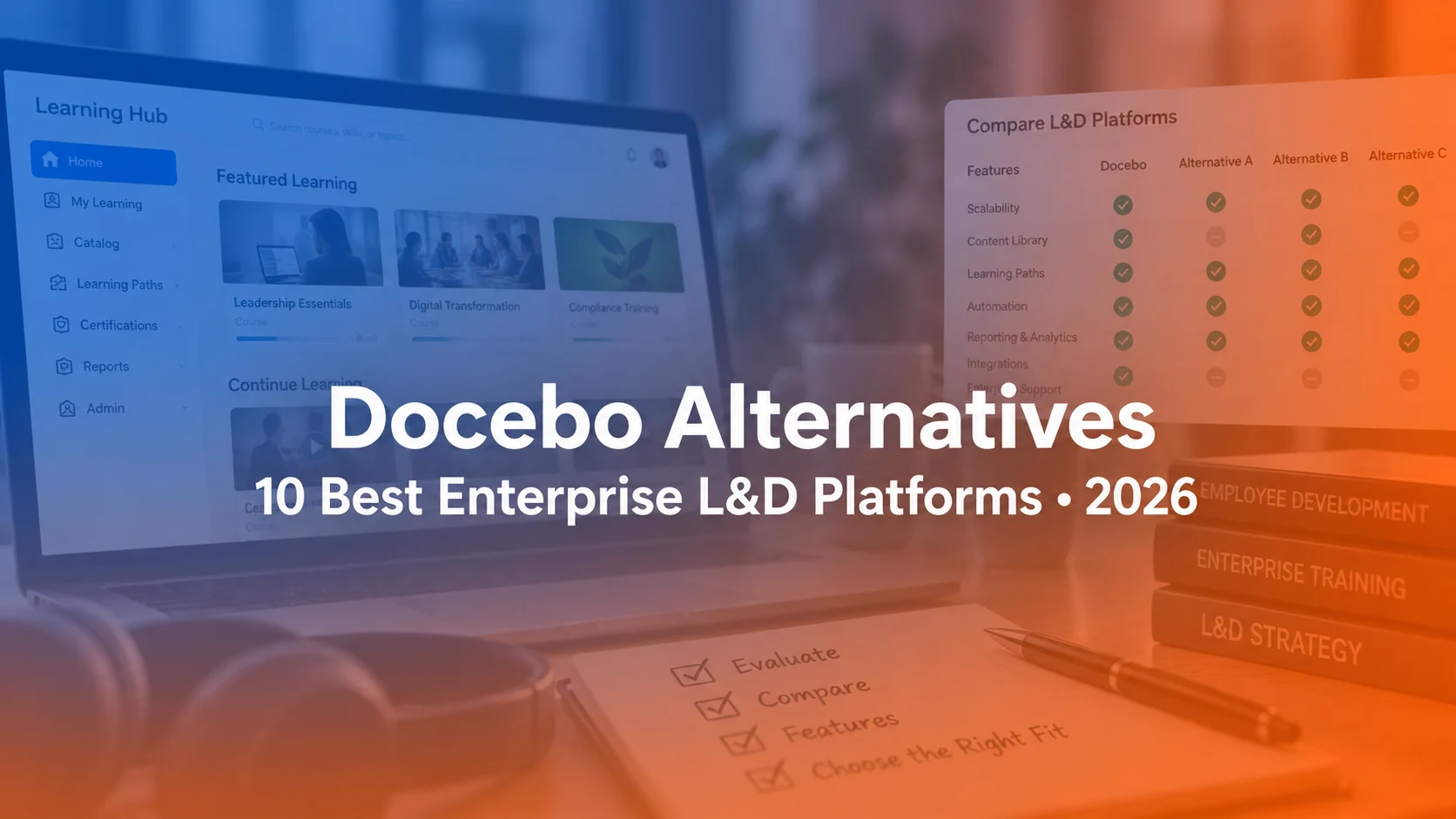

Organizations searching for Docebo alternatives are rarely solving the same problem. One enterprise may want simpler administration. Another may need tighter compliance and credential controls, more predictable multi-audience training, stronger live-training operations, collaborative authoring, deeper skills intelligence, or a different implementation and support model. The right shortlist therefore starts with the operating problem that triggered the evaluation—not with a generic feature checklist.
This guide compares ten platforms enterprise L&D teams can evaluate in 2026. Trainery.ai publishes this article and TraineryLMS appears first, so that commercial relationship is disclosed. The comparison uses public product information reviewed on September 26, 2026, plus enterprise LMS evaluation criteria commonly used in migration and procurement projects. Capabilities, packaging, availability, security, implementation scope, and contract terms should still be validated directly with each shortlisted vendor.
Why enterprise teams evaluate Docebo alternatives in 2026
Docebo itself changed materially in 2026. At Docebo Inspire 2026, the company announced a broader platform direction combining learning, enterprise knowledge, skills intelligence, agentic AI, and an MCP server that can connect learning data with AI assistants. Docebo's own product pages also distinguish between capabilities that are already available and features such as AgentHub that are still rolling out. That means a replacement project should compare a current Docebo configuration with current alternatives—not an older picture of the platform. See Docebo's 2026 platform announcements and AgentHub availability.
Typical evaluation triggers still include administrator workload, reporting and analytics, compliance workflows, content authoring, learning paths, multi-audience delivery, ILT and VILT operations, integrations, skills strategy, support, implementation complexity, and total operating cost. These are procurement categories, not claims that every Docebo customer experiences the same issue.
Write each concern as a workflow. “Reporting is difficult” is vague. “A regional L&D manager cannot produce completion by location, role, requirement, and due-date status without exporting and merging data” can be demonstrated, timed, and scored.
How we evaluated Docebo alternatives
This is a use-case shortlist rather than a universal ranking. We compared the platforms against the requirements that most often determine whether an enterprise LMS replacement succeeds after launch:
For a repeatable procurement framework, use Trainery's LMS vendor evaluation and RFP guide, LMS security checklist, and LMS migration checklist.
10 Docebo alternatives at a glance
| Platform | Best reason to evaluate | Primary fit to test | Migration question |
|---|---|---|---|
| TraineryLMS | Connected learning and training operations | LMS, TMS, credentials, coaching, compliance, and external audiences | How are historical learning, live-training, and credential records migrated? |
| Absorb LMS | Dedicated enterprise LMS administration | Administration, reporting, content, integrations, and external learning | Which workflows require configuration or paid add-ons? |
| LearnUpon | Multi-audience learning with newer agentic automation | Employee, customer, partner, and association learning | How are audiences, automations, and historical records separated? |
| 360Learning | Collaborative enterprise learning | Distributed course creation, SME knowledge, employees, customers, and partners | How are formal compliance controls preserved? |
| Litmos | Global corporate and compliance training | Compliance, integrations, content, external audiences, and AI-supported administration | How does reporting map to existing compliance definitions? |
| Cornerstone Learning | Global learning and workforce-readiness ecosystem | Compliance, skills, learning paths, content, and extended enterprise | What belongs in Learning versus adjacent suite scope? |
| TalentLMS | Lower-friction LMS operating model | Course delivery, learning paths, skills, branches, and straightforward administration | Which enterprise requirements exceed standard configuration? |
| Moodle Workplace | Configurable enterprise learning through the Moodle ecosystem | Programs, certifications, organizational structures, automation, and partner-led implementation | Which functions depend on configuration, integrations, or partner services? |
| iSpring LMS | Authoring-led training delivery | Course creation, learning paths, assessments, standards-based content, and LMS delivery | How are existing packages, versions, and learning history preserved? |
| Sana Learn | AI-native learning and knowledge experience | LMS, LXP, authoring, virtual classroom, AI tutoring, and learning analytics | How do governance, integrations, and Workday strategy affect deployment? |
1. TraineryLMS
TraineryLMS is part of a broader learning and training ecosystem that connects digital learning with training management, credential tracking, coaching, compliance training, and extended-enterprise training. It is relevant when the replacement project is driven by fragmentation across several learning operations rather than by the LMS alone.
Best fit: mid-market and enterprise organizations that want learning delivery, live-training operations, certifications, coaching, external audiences, and reporting connected in one environment.
What to test: migrate one historical completion, one active learning path, one instructor-led session, and one certification record. Then change the learner's role and inspect assignments, notifications, history, reporting, credential status, and system ownership.
2. Absorb LMS
Absorb is a dedicated corporate LMS with core course delivery, instructor-led training, portals, reporting, standards-based content, integrations, and optional products for areas such as enhanced reporting and content creation. Its 2026 releases added changes to administration, reporting, integration management, and identity workflows. See Absorb's April 2026 release notes.
Best fit: organizations seeking a mature enterprise LMS operating model without making a broader HCM suite the center of the learning decision.
What to test: reproduce the reports administrators deliver every month, configure a complex audience rule, validate delegated permissions, and document which requirements depend on add-ons or implementation services.
3. LearnUpon
LearnUpon remains relevant for organizations training employees, customers, partners, and associations through separate learning portals, but its 2026 positioning is broader than a traditional multi-portal LMS. In July 2026, LearnUpon announced its Agentic Learning Platform, with AI agents and automation positioned around content, journeys, reporting, learner profiles, and administrative work. See LearnUpon's July 2026 announcement.
Best fit: L&D and customer-education teams serving multiple audiences and evaluating whether agentic automation can reduce repetitive administration.
What to test: configure the same course for employee and partner audiences with different branding, enrollment rules, identity, communications, reporting, and permissions. Then test which new agentic workflows are generally available versus beta or planned capabilities in the proposed contract.
4. 360Learning
360Learning positions itself as an AI-driven collaborative learning platform for enterprise learning, with emphasis on internal subject-matter expertise, distributed course creation, skills, and training employees, customers, and partners in one platform. See 360Learning's enterprise platform overview.
Best fit: organizations that want subject-matter experts to contribute directly to learning while L&D retains governance.
What to test: run a regulated course through authoring, expert review, approval, assignment, revision, and re-certification. Confirm how collaborative creation, ownership, versioning, and formal compliance controls work together.
5. Litmos
Litmos currently positions its enterprise offering around global scale, compliance, integrations, multi-brand external training, content, and AI-supported administration. Its enterprise materials specifically emphasize certification tracking, audit-ready reporting, major business-system integrations, and training across workforce, partner, and customer audiences. See Litmos enterprise LMS.
Best fit: corporate training programs prioritizing compliance, integrations, external audiences, and rapid operational deployment.
What to test: reproduce the exact compliance and reporting definitions used by the business today, including overdue, exempt, withdrawn, reassigned, corrected, expired, and renewed records.
Replacing Docebo? Test the workflows your team actually runs.
Bring your hardest administration, reporting, compliance, ILT/VILT, credential, and external-audience scenarios. We’ll show how Trainery handles them end to end.
6. Cornerstone Learning
Cornerstone Learning is designed for global enterprise learning and currently emphasizes compliance, certifications and renewals, skills-aligned guidance, role-based learning, content, and extended-enterprise use cases. See Cornerstone Learning.
Best fit: large organizations with complex governance, global compliance requirements, skills strategy, and a broader workforce-readiness technology program.
What to test: separate what is included in the proposed learning scope from adjacent products and services. Map every required workflow to the licensed product, integration, configuration, content, and implementation work required.
7. TalentLMS
TalentLMS is often evaluated when teams want a simpler LMS operating model. Its 2026 releases also expanded skills, learning-path administration, group supervision, native Workday connectivity, and AI-supported content features, so the platform should be assessed on current capability rather than older “basic LMS” assumptions. See TalentLMS 7.0 updates.
Best fit: small and mid-sized organizations, or enterprise business units, that value straightforward administration and do not require the same level of platform complexity as a large talent-suite deployment.
What to test: bring the hardest requirement rather than the normal learner journey. Test organizational structures, delegated administration, compliance, reporting, integrations, skills, and governance to identify where simplicity remains an advantage and where it becomes a constraint.
8. Moodle Workplace
Moodle Workplace is a licensed enterprise learning product built on Moodle LMS and delivered through Moodle's partner ecosystem. Its current enterprise positioning includes organizational structures, automation, programs, certifications, integrations, employee training, compliance, and onboarding. See Moodle Workplace.
Best fit: organizations that value configurability and are comfortable making more implementation and partner decisions in exchange for flexibility.
What to test: require the proposal to label every requirement as native, configured, integration-dependent, partner-delivered, custom-developed, or unavailable. Include upgrade, hosting, support, and maintenance ownership in the evaluation.
9. iSpring LMS
iSpring Learn was renamed iSpring LMS in late 2025. The platform remains closely connected to iSpring's authoring ecosystem and supports standards such as SCORM, AICC, xAPI, and cmi5. Its Enterprise plan is positioned for larger organizations that need more scale, control, SSO, API access, and integration options. See iSpring's product naming and enterprise update.
Best fit: teams where course production and LMS delivery are tightly linked and authoring speed is a major part of the replacement decision.
What to test: import representative SCORM packages, update them, preserve learner history, and test how revisions affect in-progress learners and reports. For broader planning, use Trainery's SCORM and xAPI migration guide.
10. Sana Learn
Sana Learn describes itself as an AI-native platform combining LMS, LXP, authoring, virtual classroom, tutoring, administration, and learning analytics. Sana is now part of Workday, while Sana Learn remains available as a standalone product; Workday also launched Workday Learning, powered by Sana, in July 2026 for Workday HCM customers. See Sana Learn and Workday's July 2026 announcement.
Best fit: enterprises that want AI-native learning, knowledge access, authoring, and analytics to be central to the learner and administrator experience.
What to test: require governance demonstrations alongside the learner experience. Test permissions, mandatory assignments, source content, sensitive information, AI-generated outputs, recommendations, reporting, integrations, and the deployment implications of Sana's relationship with Workday.
Docebo alternative selection criteria
Use criteria that reflect the reason for the replacement project. A useful enterprise scorecard should weight the workflows that create risk, cost, or delay today—not give every feature the same value.
Compare total operating cost, not online price estimates
Enterprise LMS pricing is rarely comparable from public list prices alone. Build the same three-year assumptions for every finalist: learner definition, active-user measurement, required modules, implementation, migration, integrations, support, content, sandbox environments, reporting work, internal administration, renewal terms, and exit costs.
Record what is contractually included. A vendor proposal and statement of work are more useful than a third-party headline price when implementations have different modules, services, migration responsibilities, or support levels.
Use one migration scenario for every finalist
Provide each vendor with a small but difficult sample: duplicate users, historical completions, an active certification, a learner mid-way through a path, one manager hierarchy change, one instructor-led session, and a course package that will be revised after migration.
Ask the vendor to show what imports natively, what becomes a flat historical record, what continues to drive renewal logic, what requires manual cleanup, what cannot be migrated, and who owns each correction. Use the LMS migration checklist to structure cutover, reconciliation, rollback, and ownership.
Run an exception-heavy demo
Normal enrollment is easy to demonstrate. Instead, transfer a learner, change a due date for one business unit, replace an instructor, correct a completion, expire a credential, update a course, enroll an external learner, and generate the agreed executive and audit reports. Record the number of administrator steps and any dependency on support, custom work, or professional services.
If live training is important, add a real scheduling scenario using requirements from the enterprise training management systems comparison. If external audiences matter, test the same requirements against the extended enterprise LMS evaluation guide.
Final selection guidance
The right Docebo alternative depends on what the organization wants to preserve, simplify, consolidate, or expand. TraineryLMS is relevant when learning delivery needs to connect with live-training operations, credentials, coaching, compliance, and external audiences. Absorb fits dedicated enterprise LMS evaluations. LearnUpon combines multi-audience learning with a newer agentic direction. 360Learning fits collaborative knowledge creation. Litmos fits global corporate and compliance training. Cornerstone fits broad enterprise learning and workforce-readiness programs. TalentLMS fits teams prioritizing a simpler operating model. Moodle Workplace fits configurable, partner-supported environments. iSpring LMS fits authoring-led training teams. Sana Learn fits organizations exploring an AI-native learning and knowledge experience.
Do not select from a generic feature matrix. Require every finalist to prove the same difficult workflows, migration mappings, report outputs, security requirements, integration assumptions, and commercial scope.
Compare Trainery Against Your Current Docebo Workflows
Bring the administration, migration, reporting, learning-path, ILT/VILT, credential, compliance, integration, and extended-enterprise scenarios your team needs to preserve or improve.
Book a Demo

![Time to Competency: How to Measure and Reduce Employee Ramp Time [+ Template]](https://cdn.prod.website-files.com/69df883470c17d589ab1ae87/6ab7984c17faebc383cb74bc_time-to-competency.webp)
.svg)

.svg)
.svg)

