

New York businesses evaluating employee training software should focus on annual training campaigns, new-hire assignments, interactive learning and reliable completion records. A financial services office, a retail chain and a professional services company have different workflows despite sharing a state. Choose Trainery when learning and training administration need to be coordinated, or consider a specialist compliance provider if the central requirement is an approved harassment prevention course.
Disclosure: Trainery publishes this guide and offers learning technology. The shortlist reflects public product positioning, not hands-on comparative testing or a numerical ranking. Confirm the actual module scope, integrations, support and applicable requirements before purchase.
What should New York buyers prioritize before selecting software?
Begin with the operating outcome, not a feature count. For employee training, the highest-value demonstration is one that reproduces the real work and shows what happens when records change. Use the employee training tracking software and lms for compliance training guides to define the wider category, then narrow the requirement using the assessment below. If a current tool already meets the mandatory tests, retain it rather than paying to replace functioning software.
New York annual training campaign planner
Select your actual purchasing requirements. No email required.
What makes New York requirements different?
New York State requires employers to provide annual sexual harassment prevention training that meets the state's standards. New York City has additional requirements for covered employers, including its own training and recordkeeping framework. The state employer guidance explains the relationship with city training. A purchasing team should have HR or legal establish who is covered, accepted evidence and retention periods; do not assume that NYC rules apply to the entire state. For retail employers, check current Retail Worker Safety Act obligations separately.
Source references: New York State model policy and training; State employer guidance; NYC Stop Sexual Harassment Act guidance. Regulatory guidance is a starting point for the organization's qualified reviewers, not a guarantee of compliance. Review applicability, record ownership and exceptions before configuring software.
| Operating scenario | Buying challenge | Acceptance test |
|---|---|---|
| New York City professional services | Annual compliance and employee mobility | Run a campaign and transfer an employee between offices. |
| Upstate multi-site employer | Different supervisors and site reporting | Test restricted manager views and an HR-wide export. |
| Retail organization | New hires and shift coverage | Assign approved training to a short-notice hire and track follow-up. |
| Hybrid workforce | Remote participation and accessible learning | Test interaction, supported devices and completion evidence. |
Use the scenarios as separate demo cohorts, not as claims about every employer in the region. For example, New York City professional services needs a workflow for annual compliance and employee mobility, whereas Upstate multi-site employer has a different buying challenge. Ask vendors to reproduce both and show where their system stops. The employee onboarding training program resource helps frame the related capability; lms features provides additional evaluation context.
Compare six software platforms for New York buyers
These candidates are a starting shortlist rather than a ranked list. The vendors address different parts of employee training. When two products solve different problems, do not compare them by the number of checked features; compare the complete workflow, system ownership, implementation effort and quote. A useful demonstration reveals manual work that remains after purchasing the software.
| Platform | Consider when | Ask the vendor to demonstrate |
|---|---|---|
| Trainery | TraineryLMS for employee learning and reporting, with TMS for instructor-led programs | Bring a sample annual campaign, a midyear hire, a NYC cohort and an upstate site manager. |
| EasyLlama | State-specific harassment prevention content | Show the correct jurisdiction and supervisor version; verify tracking and integration. |
| Litmos | LMS and compliance content | Confirm course coverage, updates, licensing and report fields. |
| LearnUpon | Employee and external audience learning | Show separate audience experiences and administrator access. |
| Docebo | Enterprise learning and multiple audiences | Demonstrate distinct audience permissions and a report reconciled against the HR roster. |
| TalentLMS | Straightforward corporate course delivery | Test the actual user count, branches and reporting required in the selected tier. |
For New York, shortlist TraineryLMS for employee learning and reporting, with TMS for instructor-led programs if the relevant workflows match your priorities. Compare each competitor against the same synthetic records, not a vendor-selected success story. Request the exact licensed tier, written feature scope and any required third-party services. See lms security checklist and lms vendor evaluation rfp for additional evaluation context.
Which operational requirements should a vendor prove?
Invite the responsible operational owner and an administrator to the evaluation. Create sample data representing New York City professional services and Upstate multi-site employer. Instruct the vendor to perform each test, then record pass, fail or pending. A completed task is only accepted if an authorized reviewer can retrieve understandable evidence and reconcile it with the source record.
| Requirement | Why it matters | Demo action |
|---|---|---|
| Annual campaign | Recurring employee assignments | Create a campaign with a midyear hire and compare due dates. |
| Interactive training | Approved learning experience | Show actual interaction rather than a passive video. |
| NYC and state | Different coverage and evidence | Use separate approved cohorts and retrieve correct records. |
| Employee changes | Transfers, leave and termination | Reconcile active rosters without losing history. |
| Audit evidence | Annual and historical records | Export a campaign report and compare it to source data. |
| Access | HR and local manager permissions | Validate two restricted accounts. |
Build an exception list before the demo. Test an invalid identity, a change in assignment, an incomplete record and an authorized correction. For annual campaign, the specific test is: Create a campaign with a midyear hire and compare due dates. For nyc and state, require a separate reviewer to inspect the result. A vendor that cannot reproduce the agreed evidence should not receive a passing score based on a roadmap promise. Review lms implementation checklist and lms migration when defining the supporting requirements.
See the relevant workflow live
Bring a sample annual campaign, a midyear hire, a NYC cohort and an upstate site manager.
How should a New York employer run an annual campaign across NYC and upstate sites?
Consider a company with 500 employees split across a Manhattan office, an upstate service center and remote roles. The HR team needs one source for the annual campaign while individual managers need access only to their own population. Define who falls into each approved cohort and retain the mapping when an employee moves. Ask the vendor to create a midyear hire, a person changing manager and a departing employee; verify the historic evidence is still interpretable after each change.
A separate course provider may already deliver state-approved interactive training. In that situation the key software test is how to reconcile the roster with the provider's records. Request an import with a duplicated employee identifier and an incomplete record. Review the rejected entries rather than assuming the integration works because a successful upload is possible. The HR administrator should be able to identify a missing completion without exposing unrelated information to local managers.
For recurring campaigns, request a complete annual reporting example: starting roster, additions, exclusions with approved reasons, completions and outstanding requirements. A 500-person campaign with eight minutes of manual administration per employee represents approximately 66.7 hours before any additional follow-up. Compare the vendor's actual demonstration against that baseline instead of accepting a promised saving. If reporting alone is the main gap, upgrading the current LMS may be cheaper than migrating the entire learning library.
How Trainery fits the purchasing requirements
Evaluate employee learning platform as part of TraineryLMS for employee learning and reporting, with TMS for instructor-led programs. Trainery's product portfolio separates digital learning, instructor-led administration, coaching and credential records; the exact handoffs, configurations and commercial terms must be validated. The dashboard below illustrates a relevant area to explore, not a screenshot of a customer deployment or proof of regulatory compliance.
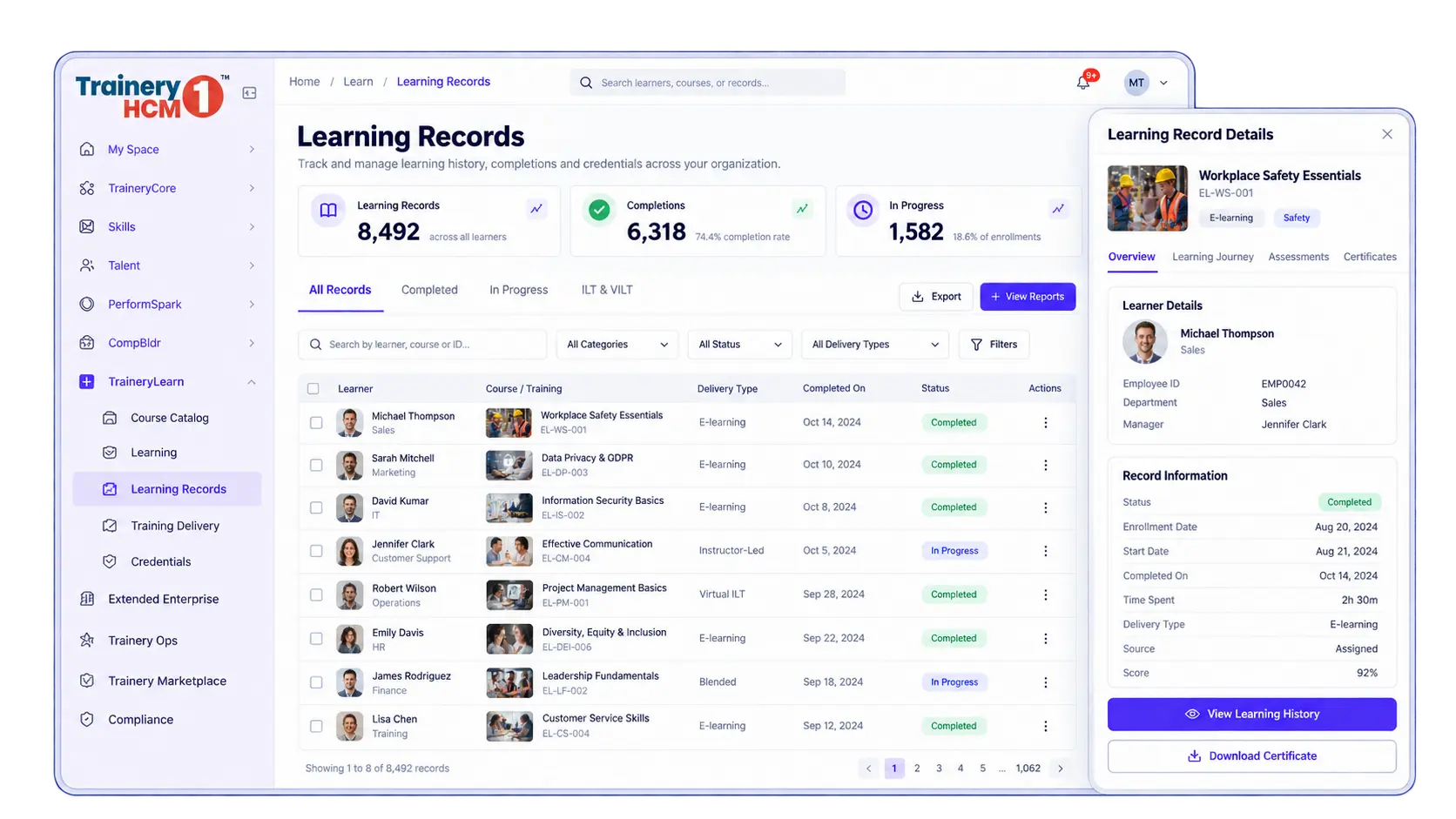
During the product review, ask the administrator to perform the relevant actions instead of describing them. For interactive training, Show actual interaction rather than a passive video. For employee changes, Reconcile active rosters without losing history. The buyer must retain control of the intended-use boundary and approval responsibilities. The related best litmos alternatives and learnupon alternatives resources help identify questions for the technical review.
Explore the acceptance workflow
Annual campaign
Recurring employee assignments. Create a campaign with a midyear hire and compare due dates.
Interactive training
Approved learning experience. Show actual interaction rather than a passive video.
NYC and state
Different coverage and evidence. Use separate approved cohorts and retrieve correct records.
Employee changes
Transfers, leave and termination. Reconcile active rosters without losing history.
How much capacity or budget should a buyer plan for?
Use your own figures instead of a vendor's generic ROI claim. The calculator models one operational constraint for New York organizations. It is not a market-price benchmark. To compare commercial proposals, ask each shortlisted vendor for identical assumptions, including workforce, site count, planned training volume and the mandatory requirements from your acceptance tests.
Annual campaign administration estimate
Replace the illustrative values with your own operating data.
| Cost item | Request in writing |
|---|---|
| Licensing | User definition, contracted minimums, module and site fees, overages, renewal price rules. |
| Implementation | Scope, migration, configuration, administrator training, acceptance criteria and timeline assumptions. |
| Content and services | Approved content, version updates, external instructors and assessment or quality services if applicable. |
| Integration and support | System ownership, data mapping, failure handling, maintenance and service response commitments. |
| Exit | Export formats, retention, access to historical evidence and transition fees. |
Evaluate the annual subscription separately from internal administrative labor and any cost of specialist systems that remain in use. The buyer's business case should explain which effort is expected to change and which obligations remain with people. Use training request approval workflow template and employee training attendance tracker template for further implementation and budget evaluation context.
How should New York buyers implement the selected software?
Run a representative pilot before expanding. Include New York City professional services and Retail organization as distinct scenarios, and assign a named owner for each record. Do not migrate unreviewed spreadsheets into the new system without agreeing which source is authoritative. Reconcile a sample of historical records and check restricted user permissions before production rollout.
| Gate | Accountable team | Pass evidence |
|---|---|---|
| Scope | Business and control owners | Approved system boundary and requirement matrix for Employee training. |
| Data | IT and administrator | Reconciled identities, assignments, records and retention rules. |
| Configuration | Vendor and business owner | Agreed module scope; demo of annual campaign. |
| Pilot | Local supervisor and reviewer | Successful tests for nyc and state and employee changes. |
| Rollout | Sponsor and operations | Exception ownership, support, reporting and escalation documented. |
Before launch, make the vendor demonstrate an export and an integration failure, not just a successful import. Confirm the owner for audit evidence and the approval boundary for access. Refer to instructor led training at scale and lms business case template for planning related work. The tms vs lms guide provides another procurement reference.
Which vendor should procurement select?
Use a common scoring method after every demonstration. A score of five means the vendor demonstrated the requirement with evidence; a score of one indicates poor fit. Pending answers remain pending. A high overall score does not override an unresolved legal, safety, security or record ownership requirement. The weights reflect the buying scenario and can be copied into your internal evaluation.
Score your shortlisted vendor
Rate each buyer criterion using the demo evidence. Leave unverified criteria pending.
What should you ask in a tailored demonstration?
Bring a sample annual campaign, a midyear hire, a NYC cohort and an upstate site manager. Ask the vendor to explain all prerequisites and required modules, then use these questions to drive the demonstration.
- Annual campaign: Create a campaign with a midyear hire and compare due dates. Ask which owner verifies the output and which steps remain manual.
- Interactive training: Show actual interaction rather than a passive video. Ask which owner verifies the output and which steps remain manual.
- NYC and state: Use separate approved cohorts and retrieve correct records. Ask which owner verifies the output and which steps remain manual.
- Employee changes: Reconcile active rosters without losing history. Ask which owner verifies the output and which steps remain manual.
- Audit evidence: Export a campaign report and compare it to source data. Ask which owner verifies the output and which steps remain manual.
- Access: Validate two restricted accounts. Ask which owner verifies the output and which steps remain manual.
Request a written proposal with the exact quoted scope, sample reporting fields and support arrangements. If an existing application can satisfy an acceptance test at lower disruption, retain it and confirm integration responsibilities. Otherwise, schedule a pilot that includes the most complex regional scenario rather than starting with the easiest department.
Build your New York software evaluation
Use your assessment results and operating example to request a Trainery demo. Confirm fit, product boundaries and commercial scope before purchase.
Book your tailored demo