


Chicago distribution centers should evaluate training management systems on instructor availability, class capacity, shift coordination and attendance reconciliation. If training is predominantly instructor-led, an LMS alone may leave administrators scheduling in spreadsheets. TraineryTMS, Training Orchestra, Administrate and Arlo are relevant shortlist candidates for training operations; a frontline LMS or assessment platform may be complementary. The operational bottleneck is the number of sessions that can be delivered without disrupting warehouse shifts.
Disclosure: Trainery publishes this guide and offers learning technology. The shortlist reflects public product positioning, not hands-on comparative testing or a numerical ranking. Confirm the actual module scope, integrations, support and applicable requirements before purchase.
What should Chicago buyers prioritize before selecting software?
Begin with the operating outcome, not a feature count. For distribution centers, the highest-value demonstration is one that reproduces the real work and shows what happens when records change. Use the best training management systems and best training scheduling software guides to define the wider category, then narrow the requirement using the assessment below. If a current tool already meets the mandatory tests, retain it rather than paying to replace functioning software.
Chicago instructor and session capacity assessment
Select your actual purchasing requirements. No email required.
What makes Chicago requirements different?
The Chicago Metropolitan Agency for Planning identifies the region as a major intermodal freight hub, connecting road, rail, air and other modes. Facilities near O'Hare and regional freight corridors may coordinate different shifts, seasonal demand and shared training resources. For covered powered industrial truck operations, OSHA requires training and practical evaluation under 29 CFR 1910.178(l). A scheduling platform can help organize training events and records; safety personnel retain responsibility for assessing competence and determining work authorization.
Source references: Chicago regional freight hub plan; Chicago freight clusters; OSHA powered industrial truck standard. Regulatory guidance is a starting point for the organization's qualified reviewers, not a guarantee of compliance. Review applicability, record ownership and exceptions before configuring software.
| Operating scenario | Buying challenge | Acceptance test |
|---|---|---|
| O'Hare-area distribution | Overlapping shift schedules | Schedule the same course without double-booking instructors. |
| Intermodal logistics facility | Limited practical training space | Allocate approved venue capacity and equipment. |
| Regional warehouse network | Shared trainers across sites | Move a session to another site and notify affected people. |
| Peak fulfillment period | Waitlists and no-shows | Reallocate seats and reconcile attendance. |
Use the scenarios as separate demo cohorts, not as claims about every employer in the region. For example, O'Hare-area distribution needs a workflow for overlapping shift schedules, whereas Intermodal logistics facility has a different buying challenge. Ask vendors to reproduce both and show where their system stops. The instructor scheduling utilization template resource helps frame the related capability; instructor led training at scale provides additional evaluation context.
Compare six software platforms for Chicago buyers
These candidates are a starting shortlist rather than a ranked list. The vendors address different parts of distribution centers. When two products solve different problems, do not compare them by the number of checked features; compare the complete workflow, system ownership, implementation effort and quote. A useful demonstration reveals manual work that remains after purchasing the software.
| Platform | Consider when | Ask the vendor to demonstrate |
|---|---|---|
| Trainery | TraineryTMS for instructor scheduling and training operations, with LMS and Credentials where needed | Bring a three-shift roster, shared trainer, limited room and one canceled class. |
| Training Orchestra | Instructor-led scheduling and resource coordination | Demonstrate conflicting instructor and room schedules and rescheduling. |
| Administrate | Enterprise instructor-led training operations | Show session templates, resources and integration reconciliation. |
| Arlo | Course administration and registrations | Demonstrate internal and external class registration and attendance. |
| Schoox | Frontline learning and skills development | Test frontline access, role assignment and manager visibility. |
| TalentLMS | Straightforward corporate course delivery | Test the actual user count, branches and reporting required in the selected tier. |
For Chicago, shortlist TraineryTMS for instructor scheduling and training operations, with LMS and Credentials where needed if the relevant workflows match your priorities. Compare each competitor against the same synthetic records, not a vendor-selected success story. Request the exact licensed tier, written feature scope and any required third-party services. See training registration waitlist management and employee training attendance tracker template for additional evaluation context.
Which operational requirements should a vendor prove?
Invite the responsible operational owner and an administrator to the evaluation. Create sample data representing O'Hare-area distribution and Intermodal logistics facility. Instruct the vendor to perform each test, then record pass, fail or pending. A completed task is only accepted if an authorized reviewer can retrieve understandable evidence and reconcile it with the source record.
| Requirement | Why it matters | Demo action |
|---|---|---|
| Instructor conflict | Shared trainers | Schedule overlapping sessions and check conflict handling. |
| Capacity | Rooms, equipment and seats | Limit session capacity and test a waitlist. |
| Shift coverage | Operational release times | Build cohorts for three shifts. |
| Attendance | No-shows and cancellations | Reschedule and compare roster history. |
| Cost | Training costs and resources | Compare scheduled and actual costs in a sample. |
| Record handoff | LMS and credential ownership | Export training records and reconcile errors. |
Build an exception list before the demo. Test an invalid identity, a change in assignment, an incomplete record and an authorized correction. For instructor conflict, the specific test is: Schedule overlapping sessions and check conflict handling. For shift coverage, require a separate reviewer to inspect the result. A vendor that cannot reproduce the agreed evidence should not receive a passing score based on a roadmap promise. Review ilt training cost per learner calculator and training budget planning software when defining the supporting requirements.
See the relevant workflow live
Bring a three-shift roster, shared trainer, limited room and one canceled class.
How should Chicago distribution centers plan instructor capacity across three shifts?
A distribution center network has 240 employees requiring an approved instructor-led program. With 15 seats per session and six available sessions per week, the minimum plan is 16 sessions over three weeks. This assumes full attendance and does not account for qualification evaluation or time taken away from operations. The result is a staffing scenario, not a commitment that the program can be delivered safely in that time.
A meaningful TMS demo should start with an instructor assigned to two locations on the same day, a limited training room and employees who cannot be released from their shifts simultaneously. Ask the vendor to show the scheduling constraint and how an administrator resolves it. Then cancel one class, move a worker to another class and reconcile the attendance records. Compare how much of that work stays in spreadsheets, emails or local calendars.
The procurement decision should distinguish an LMS that schedules a course from a TMS that coordinates resources and exceptions. A warehouse with infrequent classes may not need separate training operations software. A regional network with shared instructors, peak-period waitlists and repeated schedule changes may benefit more. Request an actual quote for instructor and site administration, integrations and support. Do not double count the financial benefit of increased class capacity and reduced administrative work if both represent the same recovered hours.
How Trainery fits the purchasing requirements
Evaluate training operations platform as part of TraineryTMS for instructor scheduling and training operations, with LMS and Credentials where needed. Trainery's product portfolio separates digital learning, instructor-led administration, coaching and credential records; the exact handoffs, configurations and commercial terms must be validated. The dashboard below illustrates a relevant area to explore, not a screenshot of a customer deployment or proof of regulatory compliance.
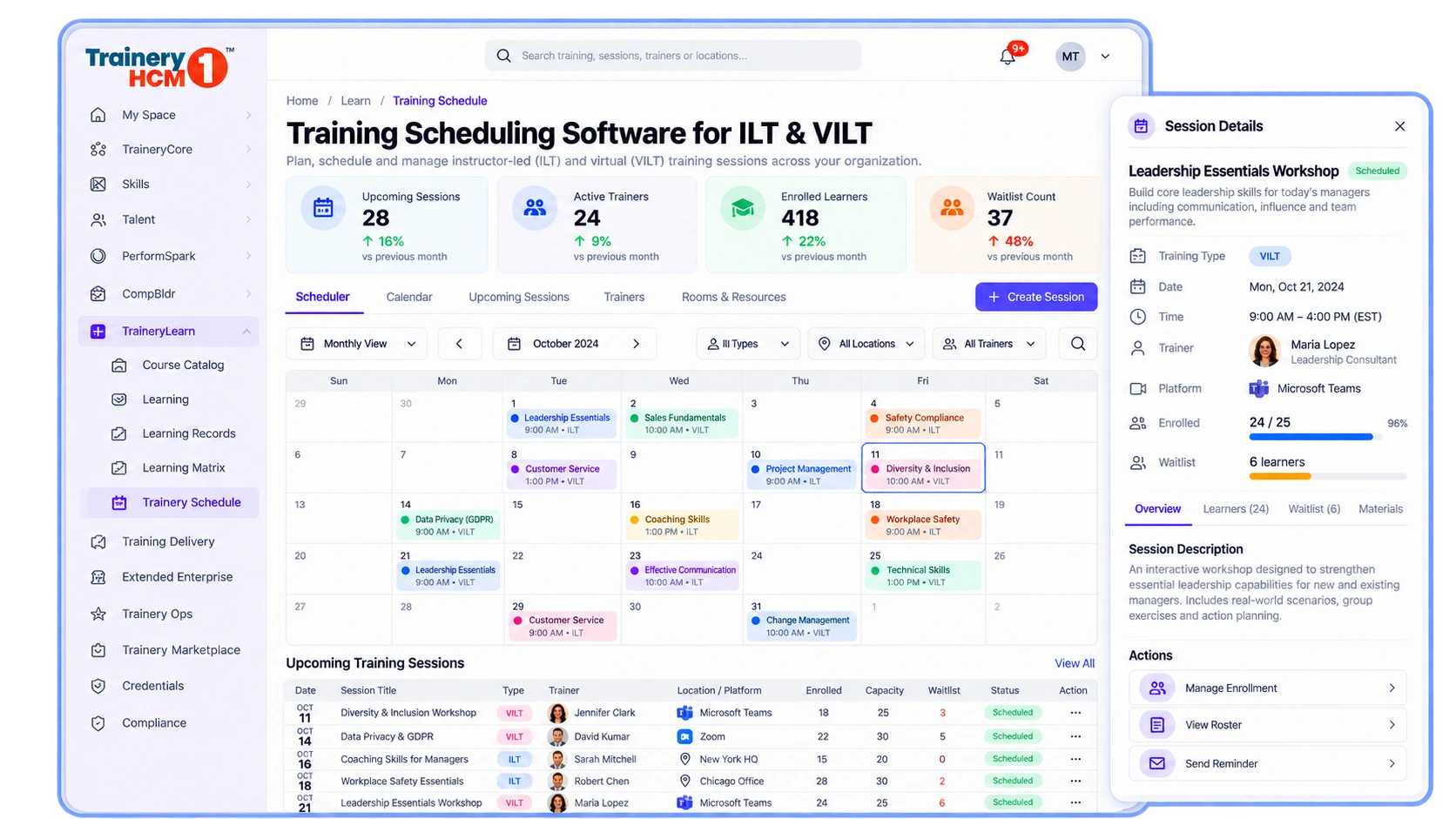
During the product review, ask the administrator to perform the relevant actions instead of describing them. For capacity, Limit session capacity and test a waitlist. For attendance, Reschedule and compare roster history. The buyer must retain control of the intended-use boundary and approval responsibilities. The related training management software pricing and administrate alternatives resources help identify questions for the technical review.
Explore the acceptance workflow
Instructor conflict
Shared trainers. Schedule overlapping sessions and check conflict handling.
Capacity
Rooms, equipment and seats. Limit session capacity and test a waitlist.
Shift coverage
Operational release times. Build cohorts for three shifts.
Attendance
No-shows and cancellations. Reschedule and compare roster history.
How much capacity or budget should a buyer plan for?
Use your own figures instead of a vendor's generic ROI claim. The calculator models one operational constraint for Chicago organizations. It is not a market-price benchmark. To compare commercial proposals, ask each shortlisted vendor for identical assumptions, including workforce, site count, planned training volume and the mandatory requirements from your acceptance tests.
Distribution center training capacity calculator
Replace the illustrative values with your own operating data.
| Cost item | Request in writing |
|---|---|
| Licensing | User definition, contracted minimums, module and site fees, overages, renewal price rules. |
| Implementation | Scope, migration, configuration, administrator training, acceptance criteria and timeline assumptions. |
| Content and services | Approved content, version updates, external instructors and assessment or quality services if applicable. |
| Integration and support | System ownership, data mapping, failure handling, maintenance and service response commitments. |
| Exit | Export formats, retention, access to historical evidence and transition fees. |
Evaluate the annual subscription separately from internal administrative labor and any cost of specialist systems that remain in use. The buyer's business case should explain which effort is expected to change and which obligations remain with people. Use arlo training software alternatives and accessplanit alternatives for further implementation and budget evaluation context.
How should Chicago buyers implement the selected software?
Run a representative pilot before expanding. Include O'Hare-area distribution and Regional warehouse network as distinct scenarios, and assign a named owner for each record. Do not migrate unreviewed spreadsheets into the new system without agreeing which source is authoritative. Reconcile a sample of historical records and check restricted user permissions before production rollout.
| Gate | Accountable team | Pass evidence |
|---|---|---|
| Scope | Business and control owners | Approved system boundary and requirement matrix for Distribution centers. |
| Data | IT and administrator | Reconciled identities, assignments, records and retention rules. |
| Configuration | Vendor and business owner | Agreed module scope; demo of instructor conflict. |
| Pilot | Local supervisor and reviewer | Successful tests for shift coverage and attendance. |
| Rollout | Sponsor and operations | Exception ownership, support, reporting and escalation documented. |
Before launch, make the vendor demonstrate an export and an integration failure, not just a successful import. Confirm the owner for cost and the approval boundary for record handoff. Refer to tms vs lms and training vendor management software for planning related work. The best lms logistics supply chain training guide provides another procurement reference.
Which vendor should procurement select?
Use a common scoring method after every demonstration. A score of five means the vendor demonstrated the requirement with evidence; a score of one indicates poor fit. Pending answers remain pending. A high overall score does not override an unresolved legal, safety, security or record ownership requirement. The weights reflect the buying scenario and can be copied into your internal evaluation.
Score your shortlisted vendor
Rate each buyer criterion using the demo evidence. Leave unverified criteria pending.
What should you ask in a tailored demonstration?
Bring a three-shift roster, shared trainer, limited room and one canceled class. Ask the vendor to explain all prerequisites and required modules, then use these questions to drive the demonstration.
- Instructor conflict: Schedule overlapping sessions and check conflict handling. Ask which owner verifies the output and which steps remain manual.
- Capacity: Limit session capacity and test a waitlist. Ask which owner verifies the output and which steps remain manual.
- Shift coverage: Build cohorts for three shifts. Ask which owner verifies the output and which steps remain manual.
- Attendance: Reschedule and compare roster history. Ask which owner verifies the output and which steps remain manual.
- Cost: Compare scheduled and actual costs in a sample. Ask which owner verifies the output and which steps remain manual.
- Record handoff: Export training records and reconcile errors. Ask which owner verifies the output and which steps remain manual.
Request a written proposal with the exact quoted scope, sample reporting fields and support arrangements. If an existing application can satisfy an acceptance test at lower disruption, retain it and confirm integration responsibilities. Otherwise, schedule a pilot that includes the most complex regional scenario rather than starting with the easiest department.
Build your Chicago software evaluation
Use your assessment results and operating example to request a Trainery demo. Confirm fit, product boundaries and commercial scope before purchase.
Book your tailored demo